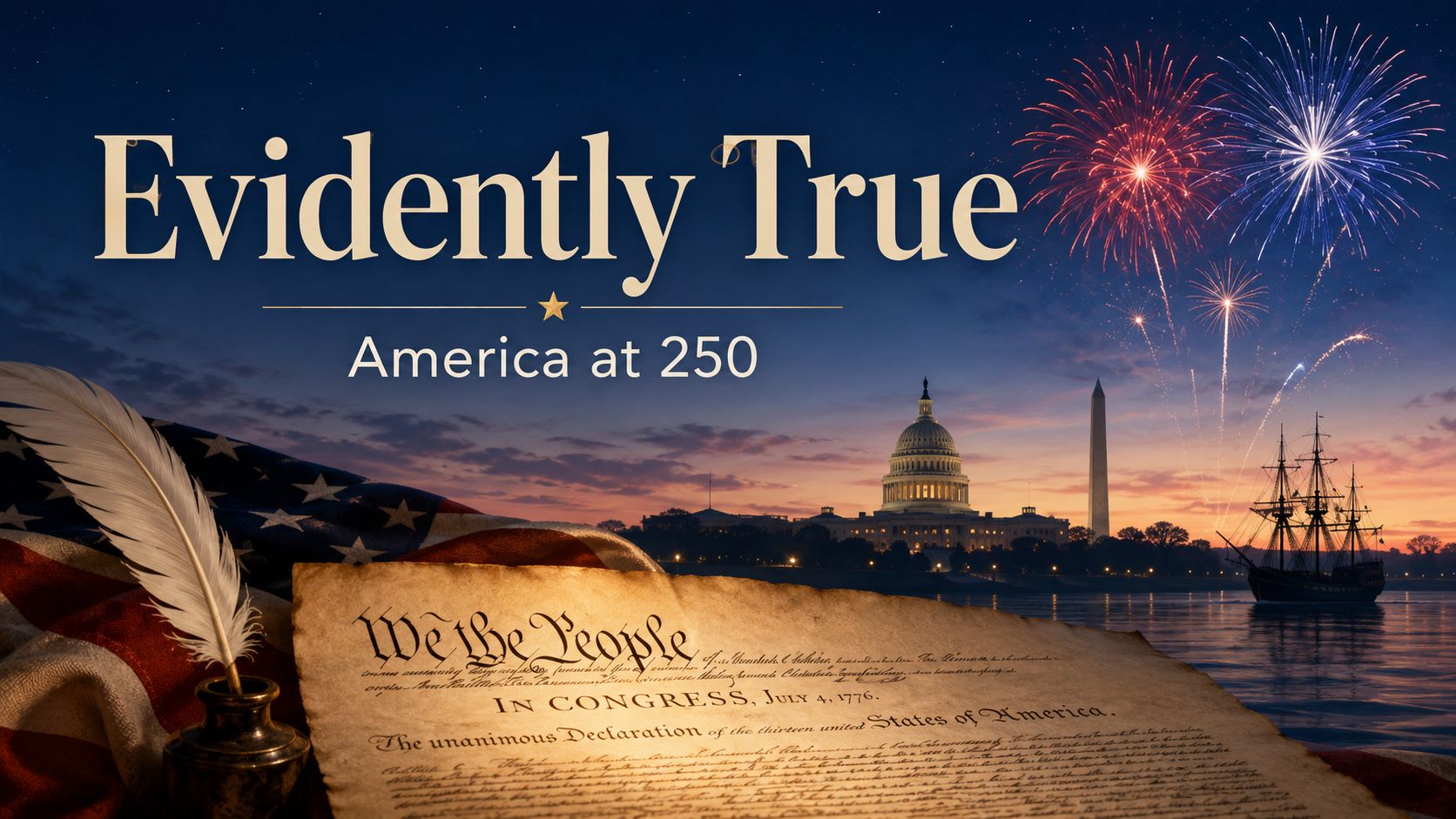

This month, as by now everyone knows, is the semiquincentennial of our country, its 250th birthday. Semiquincentennial is a lot like sesquipedalian, a curious portmanteau word for just this moment. Despite the word’s bizarre spelling and, for some, unpronounceable locution, celebrations were everywhere this past 4th of July, and none bigger than the one where Washington, D. C. exploded, literally, sometime around midnight. Yes, I’m aware that some readers are appalled by the feu d ’artifice displays, but I am not one of them. The louder, longer, and more dazzling, the better as far as I am concerned. I may have been five when I first became enamored of pyrotechnics, and I have been a fan since then, now more than fifty years.
But what, exactly, are we celebrating? I’m sure there are many different opinions on this as there are minds that think of them. But perhaps the best reason is the miraculous.
You read that right. The miraculous.
When you think about our country, there isn’t much reason that it should have survived. Begin with the Pilgrims, those ragtag, and some would say, rebellious misfits who left England in what might be described as a “huff” to find religious freedom, though they were exiled in Holland, one of the most religiously free states in Europe at the time. Sailing over the Atlantic, they were blown so far off their course (more than 250 miles) that it is a miracle they were not all washed up and left for dead. But even more than the miraculous sea survival, they ended up on the only plot of land they could have found on what was then our wild East Coast that had any chance of survival. That survival came at a hard price, but they still made it.
Coincidence, you say. Perhaps. But take the first leader of our country, Washington, whose early efforts at leadership proved a miserable failure. (If you haven’t seen Young Washington, do so before it’s gone.) Some of his failures are due to his own hubris, some to just horrible miscalculations. So badly did he lead that there is little reason that he would ever be given any chance at redemption. And yet, and yet. There he is again, leading an army against the nation he once longed to serve. He ends up again behind the eight ball, so to speak, with a charging and merciless foe, all but ready for complete annihilation. Then, the weather changes, but not merely changes as the weather is apt to do. It is a freakish change that allows him to succeed. It would not be the only time that bizarre weather saved not only Washington, but also the country in its Independence infancy. Even Lord Byron, no lickspittle he, saw his greatness:
Where may the wearied eye repose
When gazing on the Great;
Where neither guilty glory grows,
Nor despicable state?
Yes—one—the first—the last—the best—
The Cincinnatus of the West,
Whom envy dared not hate,
Bequeath’d the name of Washington,
To make man blush there was but one!
Coincidence yet again, one might argue. But what do we say about the land that Jefferson essentially backed into? In a war-ravaged part of the country, Napoleon, that immovable force at the time, held what became the Louisiana Purchase. Napoleon was not one to turn away or admit defeat, and it appeared that land and the important port in what is now New Orleans would forever be in the hands of the French. Napoleon hoped to establish a French colonial empire in North America. Still, a revolt in Saint-Domingue in the Caribbean and the impending war with the United Kingdom resulted in a volte-face. As your ninth-grade history taught, Jefferson purchased what doubled the size of the United States for eighteen dollars per square mile. That land eventually became fifteen additional states.
If these were the only stories one could tell of the miraculous life of this country, coincidence might win the day. Yet, during the Civil War conflict, a war-weary soldier picked up three cigars that had been left in an open field. He probably was looking for a way to bide his time and enjoy a smoke. But as he is about to light them, he notices that they have been wrapped in a handwritten description of the enemy’s secret battle plans. Lincoln saw this event as the supernatural sign he required to free the slaves. In this case, smoking saved and killed.
One could go on, and one, in fact, did. Michael Medved relates these and other wildly fascinating things in a book published a decade ago: The American Miracle: Divine Providence in the Rise of the Republic ( Crown Forum, NY). If you need more convincing, read his follow-up text, God’s Hand on America: Divine Providence in the Modern Era (Forum Books, 2021). You cannot read these books and not come away breathless that we live in a country that has been vouchsafed by providence and promise. I do not mean to argue that our country has not been wrong on some occasions. I am just urging readers to look at its miraculous survival.
“We hold these truths to be self evident that all men are created equal, that they are endowed by their Creator with certain unalienable Rights, that among these are Life, Liberty, and the pursuit of Happiness.” The words from the memorable Declaration’s second paragraph should not be taken as “merely” literary panache. Perhaps we do better by taking them as the miracle they were penned to describe.