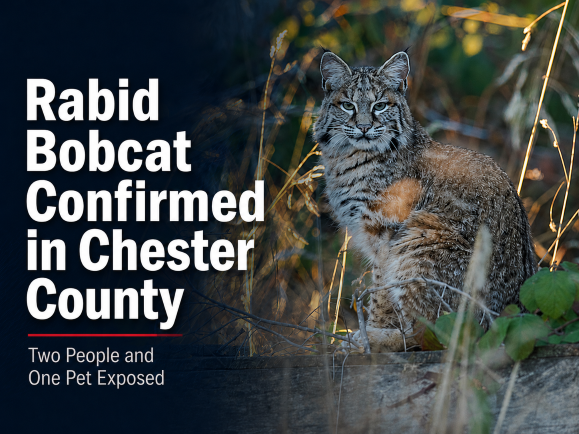

COLUMBIA, S.C. — The South Carolina Department of Public Health (DPH) confirmed that a bobcat found near Foxcroft and Huntington drives in Fort Lawn, S.C., has tested positive for rabies. Two people were exposed and have been referred to their healthcare providers. One dog was exposed and was humanely euthanized at the owner’s discretion.
The bobcat was submitted to DPH’s laboratory for testing June 5, 2026, and was confirmed to have rabies June 8, 2026. If you believe you, someone you know, or your pets have come in contact with this bobcat or another animal that potentially has rabies, please call DPH’s Columbia office at (803) 896-4680 during normal business hours (8:30 a.m.-5 p.m., Monday-Friday) or after hours and on holidays at (888) 847-0902 (Select Option 2).
“To reduce the risk of getting rabies, always give wild and stray animals plenty of space,” said Terri McCollister, Rabies Program manager. “If you see an animal in need, avoid touching it and contact someone trained in handling animals, such as your local animal control officer, wildlife control operator, or wildlife rehabilitator.” An exposure is defined as direct contact (such as through broken skin or mucous membranes in the eyes, nose, or mouth) with saliva or brain/nervous system tissue from an infected animal. If your pet is found with wounds of unknown origin, please consider that your pet may have been exposed to rabies.
It is important to keep pets up to date on their rabies vaccination, as this is one of the easiest and most effective ways to protect against the disease. This bobcat is the first animal in Chester County to test positive for rabies in 2026. There have been 47 cases of rabid animals statewide this year. Since 2002, South Carolina has averaged approximately 136 positive cases a year. In 2025, one of the 101 confirmed rabies cases in South Carolina was in Chester County.
Contact information for local Public Health offices is available at dph.sc.gov/RabiesContacts. For more information on rabies visit dph.sc.gov/rabies or cdc.gov/rabies.


Sign up here to receive the Tega Cay Sun "day" Spectator every Sunday morning with all the news from the week directly to your inbox
Thomas Hyslip lives in Tega Cay with his wife and daughter. After 27 years in the U.S. Army and Federal Law Enforcement, he retired to pursue his passion for teaching. Tom is now an Associate Professor of Instruction at the University of South Florida. In 2 short years he has won 10 awards from the South Carolina Press Association, including first place in column writing, education beat reporting and best podcast.