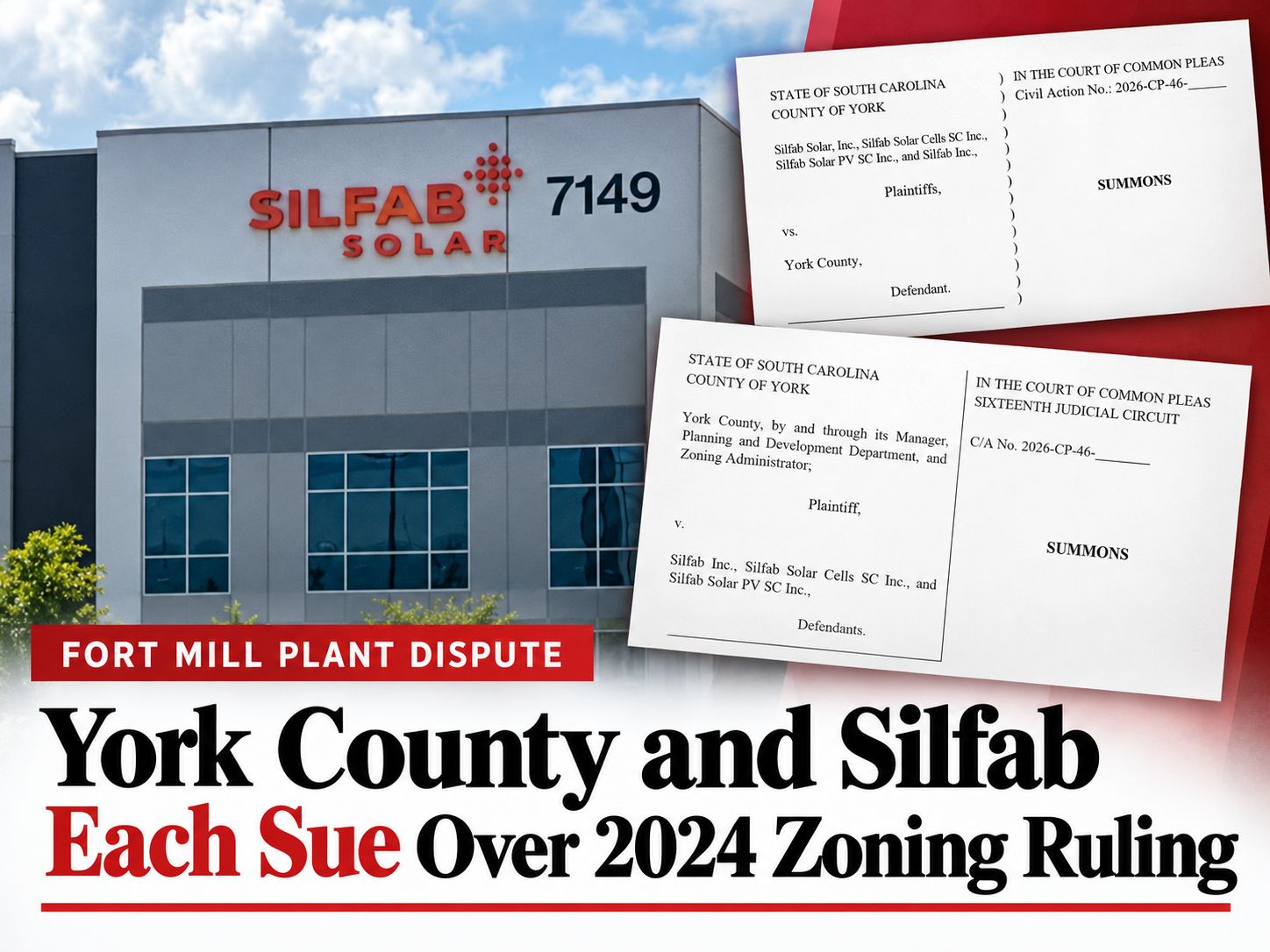

York County and Silfab Solar took each other to court Oct. 16 in lawsuits filed 19 minutes apart that pose one question: whether a 2024 county zoning board ruling against solar panel manufacturing in light industrial districts has any legal hold on the company’s plant at 7149 Logistics Lane near Fort Mill.
Silfab’s complaint was stamped at 3:09 p.m. The county’s followed at 3:28 p.m. Both are non-jury actions under the state’s Uniform Declaratory Judgments Act, which lets a court declare the parties’ legal rights without awarding money. Neither side seeks damages.
The answer could decide the plant’s future. Opponents have argued in a string of court cases that the zoning ruling obligates the county to stop Silfab or pull its permits. The county has refused, maintaining that the ruling does not reach a project it approved before the board acted. In more than two years of litigation, no court has squarely decided that point. Both new lawsuits ask a judge to do it.
What Silfab wants
Silfab, represented by Charleston attorney E. Brandon Gaskins of Moore & Van Allen, asks the court for four declarations. The first is that zoning interpretations in York County “operate prospectively only” and cannot be applied retroactively to Silfab. The second is that York County Council “ratified” the finding that solar manufacturing is allowed on the site when it enacted an incentive ordinance and approved a fee in lieu of tax, or FILOT, agreement with the company in September 2023. The third is that the county is barred, under the legal doctrine of equitable estoppel, from taking a contrary position “regardless of the outcome” of the pending zoning appeal. The fourth is that Silfab holds vested rights under state law and common law dating no later than April 24, 2024, when the county approved its civil construction plan.
The complaint lays out a timeline of county assurances. In December 2022, when the company was known to the county as “Project Mountie,” Planning and Development Services Director Jonathan Buono wrote that zoning staff “affirms the electrical equipment, appliance, and component manufacturing use, which is a permitted use in LI by right,” according to the complaint. A Dec. 27, 2022, zoning verification letter followed. Silfab says it finalized its lease in March 2023 relying on those confirmations and has since invested “hundreds of millions of dollars” in the facility and its workforce.
Silfab also quotes a June 25, 2024, county statement that said the zoning board decision “did not apply to Silfab” and “applies only to future projects in the light industrial district.”
The company’s complaint states that County Council has authorized the filing of a declaratory judgment action and that “certain members of County Council have indicated their intentions to force Silfab to stop or curtail its operations.” It does not name them.
Silfab says it appealed the 2024 zoning decision “to preserve future opportunities for growth and investment at the site and to resolve the confusion it created, not because the BZA Decision applies to Silfab’s existing approvals.”
In a statement released Friday, Silfab said the lawsuit should be unnecessary because the company already holds “all permits and approvals needed to operate,” but that it hopes the case “will bring finality to the uncertainty caused by a small but vocal minority.” The company called its filing “in alignment with York County’s efforts to achieve what we believe is a mutually agreeable outcome.”
The statement also said Silfab’s opponents “have abused the zoning processes to improperly challenge County Council’s legitimate actions to recruit Silfab to our specific site.” A ruling in the company’s favor, Silfab said, would assure future employers they can invest “without fear that zoning processes will be weaponized against them.”
What the county wants
The county’s complaint, filed by Columbia attorneys Chad N. Johnston of Burr & Forman and Jonathan M. Robinson of Smith Robinson, names Silfab Inc., Silfab Solar Cells SC Inc. and Silfab Solar PV SC Inc. as defendants. It asks the court to answer four questions. What legal effect do zoning interpretations have under the county code? Must the county take enforcement action, such as stop work orders, against a use it already approved when a later interpretation calls that use into question? Does the zoning board’s order, as affirmed in circuit court, have “any legal effect on Silfab, its currently-approved operations, and the approvals and permits issued by the County”? And does the zoning code’s interpretation section improperly hand County Council’s exclusive power to amend the code to the zoning administrator or the zoning board?
The county argues the interpretation procedure was written to clear up ambiguous language in the code and was never meant as a way to challenge a specific company or parcel. It says the process has been used “in a manner inconsistent with the Zoning Code’s plain language and the County’s historical interpretation of those procedures.” State law says local governments “may” take enforcement action against zoning violations, and the county cites a January 2026 York County circuit court order that said “where there is discretion, no duty exists.”
The county also points to a 2009 S.C. Attorney General’s opinion involving the Town of Six Mile, which concluded that only a town council can amend a zoning ordinance and that an unappealed decision by a zoning administrator “has no impact” on it.
The ruling at the center of both cases
The dispute traces to a Feb. 1, 2024, request from Walter Buchanan, who owns property next to the Silfab site on Baxter Lane. He asked the county for a zoning interpretation and posed seven questions, most naming Silfab, including how the county could allow “a use that produces deadly toxic air pollutants next to two schools and nearby residences.”
Zoning and Development Standards Administrator Rachel Grothe responded Feb. 16, 2024, that she found no ambiguity in the sections Buchanan cited, but she explained that solar panel manufacturing falls under the “Computer and Electronic Product Manufacturing” use, which is permitted in light industrial districts. Buchanan appealed to the York County Board of Zoning Appeals and named Andy Lytle to speak for him.
At the May 9, 2024, hearing, the board’s chair said the case “has no specific reference to any particular location, any particular project,” according to a transcript excerpt filed with the county’s complaint. The board voted 5-0 to reverse Grothe. Its May 30, 2024, written order found that solar panel manufacturing is not listed as a use in the light industrial district “and is therefore prohibited.” The order does not mention Silfab or its property.
By then, the county had already approved Silfab’s civil construction plan. Permits continued after the board’s ruling. The county issued a temporary certificate of occupancy in October 2025 and a full certificate of occupancy Feb. 13, 2026, according to both complaints.
Silfab and its landlord, Exeter 7149 Logistics, appealed the board’s order. Circuit Judge William A. McKinnon affirmed it July 21 and denied reconsideration Aug. 27. Silfab has appealed to the S.C. Court of Appeals, which keeps the board’s order on hold for now.
A judge has already weighed one of Silfab’s arguments
McKinnon’s amended order, filed as an exhibit by the county, addressed an argument Silfab raises again in its new lawsuit. In that appeal, Silfab argued that the FILOT agreement’s language ratifying “all prior actions taken with respect to the Project” meant County Council had approved the zoning verification.
McKinnon rejected it. He wrote that the FILOT documents were not part of the record before him and that, even if they were, a fee in lieu of tax agreement is a tax incentive and does not amend the zoning code. Accepting Silfab’s theory, he wrote, “would permit Council to amend the zoning ordinance by side agreement, in violation of § 6-29-760 and of the bar on contract zoning.”
The order also noted that the December 2022 verification letter was issued by a zoning technician to a third-party due diligence firm and stated on its face, “This letter does not constitute a permit.”
The judge cited evidence the board heard, including Silfab’s state air permit application, which listed hydrofluoric acid, hydrochloric acid, potassium hydroxide and silane, and an acid scrubber stack raised from 19.7 feet to 70 feet.
McKinnon’s ruling did not decide whether the board’s order applies to Silfab’s already permitted plant, and York County was not a party to that appeal. Both new complaints point to that gap.
The attorney general’s questions
Following incidents at the plant in March, S.C. Attorney General Alan Wilson wrote to York County Council Chairwoman Christi Cox on March 17. His letter, filed as an exhibit, asked eight questions, including whether council ever ratified the staff zoning decision and “what effect, if any, should be given to the York County Board of Zoning Appeals’ decision.” He urged the parties to ask the court to expedite the case “so that a decision can be reached as soon as possible.”
County Manager Josh Edwards replied April 2 that “the County’s position remains that all zoning approvals and permits were properly issued.” He wrote that council “did not review or otherwise ratify the zoning compliance approval issued to Silfab,” although the FILOT agreement ratified the earlier verification letter, and that council’s ratification “was not prospective.” Edwards listed eight county permits issued to Silfab after the board’s ruling.
On the board’s decision, Edwards wrote that the county has “historically treated zoning interpretations as prospective only and improper for the purpose of challenging specific projects under use or in development.”
Years of litigation
The county’s complaint lists six other cases tied to the plant. They include a class action filed in September 2024 by Citizens Alliance for Government Integrity, or CAGI, which a judge stayed in January 2025 until the zoning appeal is final; two petitions to the S.C. Supreme Court, one by a Fort Mill resident and one by CAGI, seeking stop work orders or permit revocations, both denied; a lawsuit by resident Dennis Bivens dismissed in January 2026 and now on appeal; and an appeal by resident John Lee of the zoning board’s 3-2 decision on a second interpretation request, still pending in circuit court.
The county’s filing also reports that the U.S. Supreme Court denied a CAGI petition for review on Oct. 5.
After McKinnon upheld the zoning board in July, CAGI asked the court to lift the stay on its class action and sought an injunction against Silfab and an order forcing the county to act. McKinnon declined to lift the stay, and CAGI withdrew the injunction request. CAGI asked him to reconsider on Sept. 30. As of Friday’s filing, that motion had not been set for argument, according to the county.
What comes next
Under the summonses, each side has 30 days after being served to answer the other’s complaint. No hearing has been set in either case. Silfab’s appeal of the zoning board’s decision remains pending before the S.C. Court of Appeals.
The cases are Silfab Solar Inc. et al. v. York County, No. 2026-CP-46-03785, and York County v. Silfab Inc. et al., No. 2026-CP-46-03786. York County exhibits.

Sign up here to receive the Tega Cay Sun "day" Spectator every Sunday morning with all the news from the week directly to your inbox
Thomas Hyslip lives in Tega Cay with his wife and daughter. After 27 years in the U.S. Army and Federal Law Enforcement, he retired to pursue his passion for teaching. Tom is now an Associate Professor of Instruction at the University of South Florida. In 2 short years he has won 10 awards from the South Carolina Press Association, including first place in column writing, education beat reporting and best podcast.