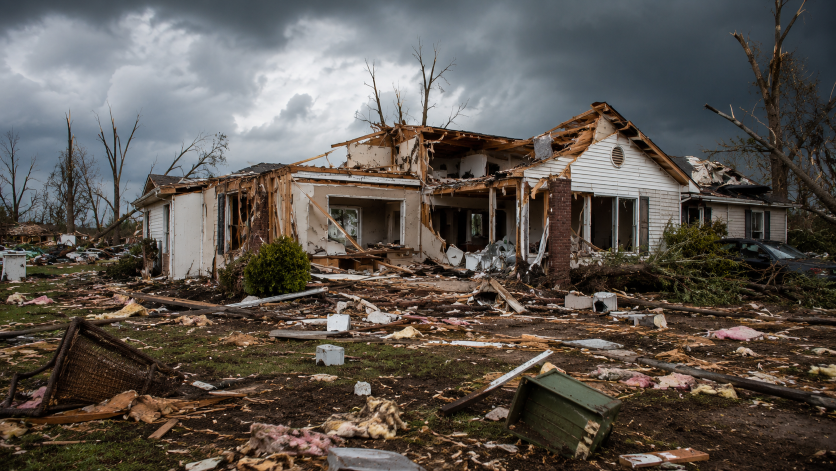

There is a photo circulating on Facebook of a local home destroyed by a tornado, with a plea for donations to help the family rebuild. The image looks heartbreaking and real. The damage is vivid, the sky behind the rubble looks ominous, and the detail is extraordinary.
It never happened. There is no tornado. There is no family. The entire image was generated by artificial intelligence in a matter of seconds, and the donation link leads straight to a criminal’s bank account.
This is the new frontier of online deception, and it is arriving faster than most people realize. Last week Dr. Tom wrote about AI voice cloning being used right here in York County to impersonate a real sheriff’s deputy. This week the threat takes a different form, but the underlying technology is the same and the consequences are just as real.
What Are AI-Generated Images and Why Are They So Dangerous
A deepfake image is a photograph or video that has been created or manipulated by artificial intelligence to depict something that never actually happened. The term comes from a combination of deep learning, the AI technique behind the technology, and fake. Early deepfakes were crude and relatively easy to spot. That era is over.
Modern AI image generators like Midjourney, DALL-E, and Stable Diffusion can produce photorealistic images of people, places, and events that never existed, in seconds, at virtually no cost. In 2025, people over 60 filed more than 200,000 fraud complaints related to AI-enabled scams, with losses totaling $7.7 billion according to the FBI’s Internet Crime Complaint Center. A recent Quinnipiac University poll found that 42% of participants were either not confident or not at all confident that they could spot AI-generated videos or audio recordings.
The technology has outpaced our instincts. We were taught from childhood that photos do not lie. That assumption is now a liability.

A Case That Shows How Far This Technology Has Gone
Dr. Tom was recently interviewed by WFLA News in Tampa about a disturbing case that illustrates exactly how far AI image generation has gone into criminal territory. Brian Schaaf, 30, a co-owner of the Robeks smoothie shop in Tampa, was arrested after the National Center for Missing and Exploited Children sent detectives a tip regarding apparent child pornography images uploaded to Google’s servers. Investigators traced the account to Schaaf’s home, where a search warrant uncovered additional images. He now faces more than 100 felony charges including solicitation or possession of child pornography and generating altered sexual depictions without consent.
What made this case significant from a technology standpoint is that the material was AI-generated. No real child was directly photographed. The images were fabricated entirely by artificial intelligence.
“Unfortunately, now they don’t even need a picture of a real kid,” Dr. Tom told WFLA. “They can have AI do an entire thing. And thankfully, Florida statutes cover that so they can charge somebody if they do that.”
The legal standard matters here. “If a real person would think it was a real child, that’s what the law says,” Dr. Tom explained. “And so they can charge anybody for possessing or producing child pornography.”
How Criminals Are Using Fake Images Right Now
Beyond the most serious criminal applications, AI-generated images are being deployed across several overlapping categories of fraud targeting ordinary people every day.
Disaster and charity scams. Criminals generate fake images of floods, fires, hurricanes, and war zones and post them to social media alongside urgent donation requests. After every real disaster, a wave of fake imagery follows within hours, designed to siphon donations away from legitimate relief efforts.
Fake investment promotions. Scammers create realistic-looking videos and images of well-known financial personalities, news anchors, or celebrities appearing to endorse investment opportunities. Michigan Attorney General Dana Nessel warned specifically about fake investment ads on Facebook and Instagram using AI-generated images of recognizable public figures. The celebrities never said any of it. The investment does not exist.
Romance scam profile photos. AI has supercharged romance scams by generating entirely new faces that do not belong to any real person and therefore cannot be reverse-image-searched. In Hong Kong, a romance scam using AI deepfake technology lured victims into giving more than $46 million to a criminal group.
Fake news and misinformation. AI-generated images of politicians, public figures, and local officials in compromising or fabricated situations are used to spread false narratives, damage reputations, and manipulate public opinion. These images can circulate widely before anyone catches up with a correction.
Identity fraud. Criminals use AI-generated faces to create fake government ID photos, bypassing identity verification systems at banks, financial platforms, and online services.
How to Spot a Fake Image
The honest answer is that with the best modern AI tools, it is genuinely difficult and getting harder every month. The old advice, check for weird teeth or strange lighting, addressed problems that current AI generators have largely solved. However, there are still reliable tells worth knowing.
Look at the hands and fingers. AI image generators have historically struggled with hands. Extra fingers, fused knuckles, and unnatural bends remain one of the most consistent giveaways in AI-generated photos. Always check the hands first.
Look at the background details. Text in the background of AI images is frequently garbled or nonsensical. Signs, labels, license plates, and book spines are all areas where AI tends to produce convincing-looking but meaningless characters rather than real words.
Look at the edges of faces and hair. AI faces often lose coherence around the hairline, ears, and the edges where face meets background. Hair in particular tends to look either unnaturally perfect or strangely blurred where it meets the surrounding image.
Look at the eyes. AI-generated eyes often look glassy, perfectly symmetric, or have reflections that do not match the scene around them. Real eyes have irregular detail and subtle asymmetry that AI consistently struggles to replicate.
Look at jewelry and accessories. Earrings, glasses, and necklaces in AI images frequently show asymmetry, melting edges, or duplicated elements on closer inspection.
Use your skepticism as a tool. If an image makes you feel an immediate strong emotional reaction, especially urgency or outrage, that is the moment to slow down rather than share or donate. Criminals engineer images specifically to trigger emotion before reason kicks in.
Free Tools That Can Help
You do not have to rely on your eyes alone. Several free tools can help you evaluate whether an image is real or AI-generated.
Google Reverse Image Search. Right-click any image and select Search Image with Google. If a supposedly local or recent photo shows up on dozens of unrelated websites dating back years, it is almost certainly stolen or fabricated.
TinEye. A dedicated reverse image search tool at tineye.com that searches billions of images to find where a photo has appeared before.
Hive Moderation. A free online AI detection tool at hivemoderation.com that analyzes uploaded images and provides a probability score for whether they were AI-generated.
Illuminarty. Available at illuminarty.ai, this tool specifically checks for AI-generated imagery and highlights suspicious regions of a photo.
None of these tools are foolproof. Detection technology is in an arms race with generation technology, and generation is currently winning. But running a suspicious image through even one of these tools takes less than a minute and can save you from sharing misinformation or losing money to a scam.
The Bottom Line
Last week’s column showed how AI can clone a real person’s voice to deceive people over the phone. This week’s column shows how AI can fabricate a real-looking photograph to deceive people on screen. Together they represent a fundamental shift in what it means to verify information in 2026.
The old standard, I will believe it when I see it, has been quietly retired. The new standard needs to be: I will verify it before I share it or act on it.
Stay safe out there, and I will see you next week!
Feeling lost in the digital world? Dr. Tom is here to help!
References
- WFLA News. “Disgusting and Vile: Locals React to Arrest of Tampa Business Owner on AI Child Porn Charges.” June 2026. https://www.wfla.com/news/hillsborough-county/disgusting-and-vile-locals-react-to-arrest-of-tampa-business-owner-on-ai-child-porn-charges/
- WFLA News. “Disturbing and Incomprehensible: Co-Owner of Tampa Smoothie Shop Accused of Creating AI-Generated Child Pornography.” June 2026. https://www.wfla.com/news/hillsborough-county/disturbing-and-incomprehensible-co-owner-of-tampa-smoothie-shop-accused-of-creating-ai-generated-child-pornography/
- U.S. Immigration and Customs Enforcement. “Florida Man Pleads Guilty to Producing, Distributing, Creating Thousands of Images Depicting CSAM Using AI.” February 2025. https://www.ice.gov/news/releases/florida-man-pleads-guilty-producing-distributing-creating-thousands-images
- National Council on Aging. “Understanding Deepfakes: What Older Adults Need to Know.” May 2026. https://www.ncoa.org/article/understanding-deepfakes-what-older-adults-need-to-know/
- Mission Cloud. “How to Detect Deepfakes in 2026.” January 2026. https://www.missioncloud.com/blog/how-to-detect-deepfakes-in-2026
- Kaspersky. “How to Protect Yourself from Deepfake Scammers.” February 2026. https://www.kaspersky.com/blog/how-to-recognize-a-deepfake/55247/
- Equifax. “Is It Fake? How to Identify Deepfake and AI Scams.” January 2026. https://www.equifax.com/personal/education/identity-theft/articles/-/learn/identify-deepfakes-ai-scams/


Sign up here to receive the Tega Cay Sun "day" Spectator every Sunday morning with all the news from the week directly to your inbox
Thomas Hyslip lives in Tega Cay with his wife and daughter. After 27 years in the U.S. Army and Federal Law Enforcement, he retired to pursue his passion for teaching. Tom is now an Associate Professor of Instruction at the University of South Florida. In 2 short years he has won 10 awards from the South Carolina Press Association, including first place in column writing, education beat reporting and best podcast.