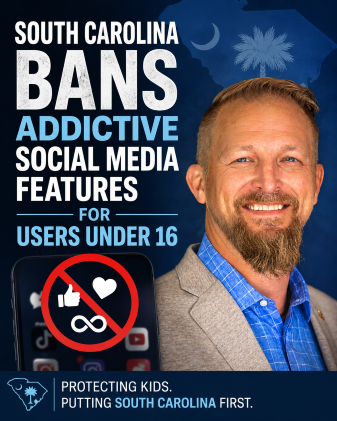

Gov. Henry McMaster has signed a new state law that will strip autoplay videos, infinite scrolling, push notifications and like counts from the social media accounts of South Carolina users younger than 16. The measure was championed by state Rep. Brandon Guffey, a York County Republican whose teenage son died by suicide after an online sextortion scam.
The law, called the Stop Harm from Addictive Social Media Act, aims to protect the mental health of children by cutting off design features the state considers addictive and by giving parents more control over how their children use major platforms. For families across York and Lancaster Counties, it means the largest social media companies will soon have to identify younger users in South Carolina, change what those accounts can do and seek a parent’s permission before a child can keep an account.
A York County lawmaker leads the effort
Guffey, who lives in Rock Hill, has pushed for stronger online protections for children since his son Gavin, who was 17, died by suicide in July 2022. Guffey has said a stranger posing as a young woman on Instagram coerced Gavin into sending intimate images, then tried to extort him for money. After his son’s death, Guffey sponsored Gavin’s Law, the 2023 measure that made sexual extortion a felony in South Carolina. He has since carried that advocacy to Congress and the White House.
Guffey has described social media companies as “the big tobacco of this generation” and has said he hopes the new state law becomes a model for the rest of the country.
What the law changes
For account holders younger than 16, the law bans a set of features it labels addictive, including continuously loading feeds known as infinite scrolling, autoplay videos, push notifications alerting users to new content, and content metrics such as like counts. Those restrictions apply even when a parent has given consent. The law also prohibits targeted advertising to children and younger teens and adds privacy requirements for how platforms handle minors’ personal information. Parents will be able to monitor and limit the amount of time their children spend on covered platforms.
How age estimation would work
Rather than requiring users to upload a government identification, the law directs covered platforms to estimate the age of account holders based on their activity and the birthdate tied to the account. A covered platform is defined as a company that generated at least $1 billion in advertising revenue worldwide in one or more of the preceding three years, a threshold that captures platforms such as Instagram and TikTok.
A platform must begin estimating a user’s age after the account has been active for a set number of hours, then refine that estimate as use continues. According to written testimony NetChoice submitted in opposition, platforms would have to estimate within 14 days of a user reaching 25 hours of use over six months whether that user is older than 17, with 80 percent confidence, and raise that confidence to 90 percent once the account reaches 50 hours. Accounts that have been active for seven or more years are exempt from the age estimation requirement. The law creates a private right of action for affected families and allows penalties of $10,000 per violation.
Industry pushes back
NetChoice, a trade group whose members include Meta, Google, TikTok and YouTube, opposed the bill as it moved through the General Assembly. Amy Bos, a vice president for the group, argued that the measure violates free speech protections and functions as a digital identification mandate that could put children’s data at greater risk. NetChoice has already sued the state over a separate law McMaster signed Feb. 5 aimed at minors online, the South Carolina Age Appropriate Design Code Act. That case, NetChoice v. Wilson, is pending in federal court on First and Fourteenth Amendment grounds.
When the law takes effect
The Stop Harm from Addictive Social Media Act cleared the General Assembly with broad bipartisan support and was signed May 19. It is scheduled to take effect Jan. 1, 2027, leaving the largest platforms about seven months to build the age estimation systems the law requires.
Whether the law survives a likely legal challenge remains an open question, given the pending case over the state’s earlier measure. For now, families in York and Lancaster Counties have until the start of next year before the changes reach their children’s screens.
If you or someone you know is in crisis, the 988 Suicide and Crisis Lifeline is available by call or text at 988.
Sources: South Carolina House Bill 4591, the Stop Harm from Addictive Social Media Act, as posted by the South Carolina Legislature; the Office of Gov. Henry McMaster; written testimony submitted by NetChoice; the Alliance Defending Freedom; and reporting by The Associated Press, WIS News 10 and Live 5 News.


Sign up here to receive the Tega Cay Sun "day" Spectator every Sunday morning with all the news from the week directly to your inbox
Thomas Hyslip lives in Tega Cay with his wife and daughter. After 27 years in the U.S. Army and Federal Law Enforcement, he retired to pursue his passion for teaching. Tom is now an Associate Professor of Instruction at the University of South Florida. In 2 short years he has won 10 awards from the South Carolina Press Association, including first place in column writing, education beat reporting and best podcast.