
Council Authorizes Contract Negotiations With County Administrator Candidate, Passes Poll Worker Ordinance 6–1, and Pushes Back Hard on Administrator’s $156.4M FY27 Recommended Budget and Proposed 7-Mill Operating Increase
The Lancaster County Council convened a special meeting on May 6, 2026 at 12:00 PM in the County Council Chambers at the County Administration Building in Lancaster. After the call to order, invocation by Council Member Charlene McGriff, and unanimous approval of the agenda, Council went into executive session for approximately 49 minutes to discuss a personnel matter regarding County Administrator interviews, with representatives of the search firm Find Great People in attendance. Coming out of executive session, Council unanimously authorized Chair Brian Carnes to enter into contract negotiations with a candidate for County Administrator.
With no citizens comments received, Council moved to first reading of Ordinance 2026-2021, which classifies poll workers as separate from temporary, part-time, or full-time county employees and instead governs them under state election law and the County Board of Voter Registration and Elections; the ordinance passed 6–1 after Council Member Stuart Graham raised concerns about whether the change would eliminate drug-testing and background-check requirements.
The bulk of the meeting, running roughly two hours was devoted to a presentation by Interim County Administrator Steve Willis and Budget Director Jamie Privuznak of the FY2026–2027 recommended budget, which proposes a $156.4 million General Fund (up from $102 million adopted last year), an all-funds total of $215.7 million (up from $160.1 million), a 7-mill increase to the operating millage (raising it from 92.6 to 101 mills total countywide), and 72.5 new positions out of 91 requested. Council members across the dais expressed significant concerns about the size of the budget, the lack of certified revenue numbers, the difficulty of reading the request-vs.-recommendation comparison, and the prospect of any tax increase given current cost-of-living pressures on residents. Council also discussed in detail the long-pending fire station capital needs (Harrisburg, Indian Land/The Haven, Edgewater), the EMS schedule transition from 24/48 to 24/72 with 14 new positions, the proposed Walnut Creek soccer field turf project, salary increases (6% for Sheriff’s Office, 2% across-the-board for everyone else), the State Homestead Exemption legislation pending in Columbia and its impact on the Auditor’s Office, the 13-passenger bus replacement ranked second in the CIP, and the 1.9-million-dollar 911 radio console replacement which Communications confirmed could be deferred one more year. The administrator was directed to come back with a recommendation closer to a $115–$120 million General Fund target and to revise the budget exhibits to show year-over-year change from the FY26 adopted budget rather than only the request-to-recommendation delta. The meeting was adjourned with next steps on the budget continuing at the May 13 Committee of the Whole meeting, first reading on May 26, second reading and public hearing on June 8, and third reading and adoption on June 22.
Opening Items
Call to Order, Pledge, and Invocation. Chair Brian Carnes called the meeting to order and asked the Clerk to note for the record that a quorum was present, that public notice had been posted in the lobby of the County Administration Building and on the county website for the required length of time, and that the news media had been notified. He welcomed attendees and asked that cell phones be silenced and hats removed. Council Member Charlene McGriff led the Pledge of Allegiance and offered the invocation, asking for wisdom and knowledge for the council and remembering staff and constituents as Council went into the budget meeting.
Approval of the Agenda. A motion was made by Council Member McGriff and seconded by Council Member Steve Harper. The agenda was approved unanimously by show of hands.
Executive Session
A motion was made by Council Member Billy Mosteller and seconded by Council Member McGriff to go into executive session pursuant to South Carolina Code of Laws § 30-4-70(a)(1) for one item — discussion of a personnel matter regarding County Administrator interviews — and to invite representatives of the search firm Find Great People to participate in the discussion. The motion carried unanimously. Council was in executive session for approximately 49 minutes.
Coming Out of Executive Session. A motion to come out of executive session was made by Council Member Jose Luis and seconded by Council Member Bryant Neal; it carried unanimously. County Attorney Ginny Merck-Dupont, who was not in executive session, stated for the record her understanding that Council had met for the discussion of a personnel matter regarding County Administrator interviews and that no motions were made and no votes were taken in executive session.
Items Following Executive Session. Council Member Luis made a motion authorizing the Chair to enter into contract negotiations with a candidate for County Administrator. Council Member McGriff seconded. With no discussion, the motion carried unanimously by show of hands.
Citizens Comments
There were no citizens comments received for the meeting, so Council moved directly to the non-consent agenda.
Non-Consent Agenda — Ordinance 2026-2021 (Poll Workers)
Chair Carnes read the title of Ordinance 2026-2021 — an ordinance to adopt amended policies related to poll workers and their classification as temporary employees as included in the Lancaster County Personnel Policies and Procedures, in accordance with Lancaster County Code Chapter 2, Article IV. Council Member Harper moved to approve; Council Member McGriff seconded.
Interim County Administrator Steve Willis explained that the substantive change is found on page eight of the council package and adds the following language to Section 7.1 (Employment Status): “Poll workers appointed pursuant to South Carolina election law shall not be considered temporary, part-time, or full-time employees of the County. Such individuals shall be governed by applicable state law and policies established by the County Board of Voter Registration and Elections.”
Council Member Stuart Graham asked whether the change would mean that poll workers would no longer be required to be drug tested or undergo criminal background checks. Mr. Willis answered that under the new language poll workers would fall under the regulations of the County Board of Voter Registration and Elections rather than county personnel policy, so the requirements would not apply unless the Board of Voter Registration and Elections elected to impose them, and that currently the answer was no. Hearing no further discussion, Chair Carnes called for the vote. The motion passed 6–1 on first reading.
Discussion and Action — FY27 Recommended Budget
Chair Carnes introduced Item 9A, the presentation and discussion of the County Administrator’s recommended budget for fiscal year 2026–2027.
Opening Remarks from Steve Willis. Mr. Willis acknowledged that three council members were participating in their first budget cycle with him as administrator. He emphasized that he and staff were soliciting feedback because Council adopts budgets and administrators only recommend them, and that he had no illusion Council would approve everything in the recommendation. He asked Council to avoid across-the-board cuts because departments are not created equally — he gave the example that the Solicitor and Public Defender cannot legally be cut below their current-year funding. He also asked that any major changes happen before first reading rather than after the public hearing, since amendments after the public hearing leave citizens without a chance to comment. He invited Council to ask technical questions of department heads in the room directly.
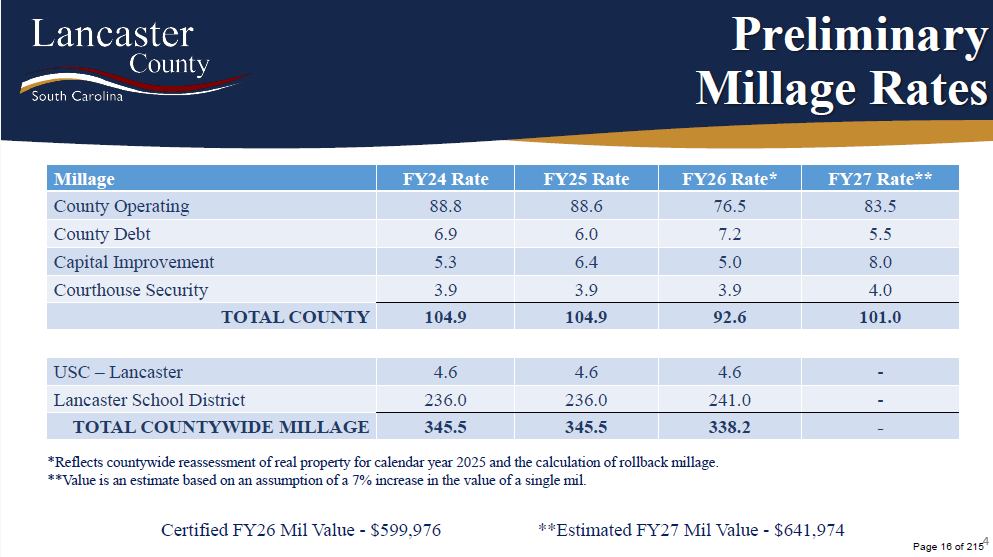
Budget Director Jamie Privuznak’s Presentation. Ms. Privuznak walked Council through the recommended budget. The recommendation is balanced based on increases to county operating, capital improvement, and court-mandated security millage rates, using a conservative assumption that the value of a single mill will increase by 7% for calendar year 2026. The preliminary total county millage rate is 101 mills, with the county operating millage rising 7 mills (from 92.6 to 101 inclusive of all county components — operating going from approximately 76.5 to 83.5). The decline shown in 2025 reflects the rollback millage adopted during the prior reassessment year.
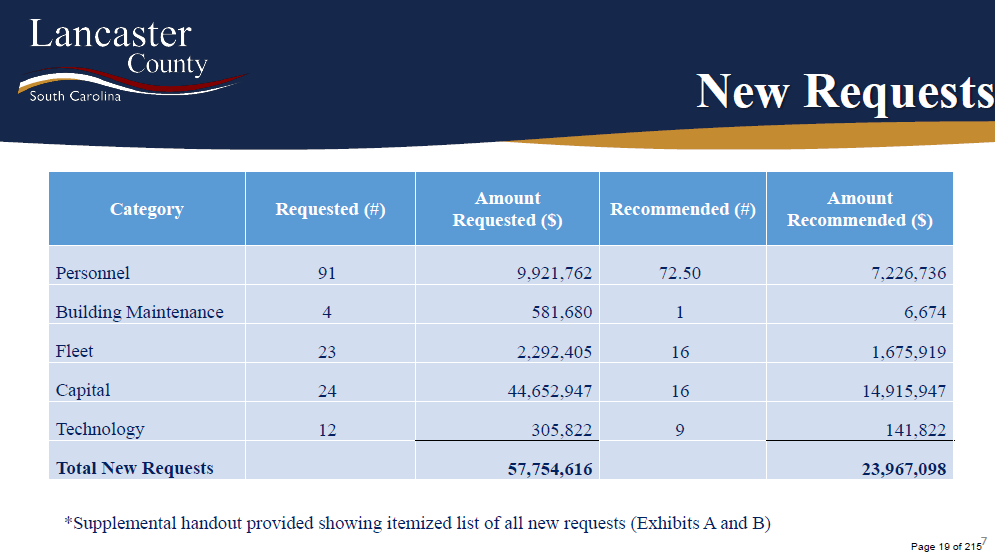
Staffing Requests. Of 91 personnel requests submitted in early March totaling $9.9 million, the administrator recommended 72.5 new positions for $7.2 million. Detailed crosswalks are included in Exhibit A and Exhibit B of the council package.
General Fund. The recommended General Fund is $156.4 million — a decrease of 5.2% from staff requests of $165 million but an increase of approximately $53–54 million from the FY26 adopted budget of approximately $102 million. Exhibit C lists each department with current adopted budget, requested amount, and recommended amount.
Council Pushback on the Numbers. Council Member Harper pressed staff on the apparent flatness of ad valorem property tax revenue between FY26 ($38 million) and the FY27 estimate ($38 million), noting that with growth from new buildings such as Costco and Target the figure should be substantially higher. Staff responded that revenue projections in the April 15 packet did not include the proposed 7-mill increase and that final certified mill values had not yet been received from the Auditor. Council Member Graham repeatedly stated that beginning a budget conversation at $156 million when last year’s adopted General Fund was $102 million was unrealistic, that the budget is “balanced” only because savings/reserves are being applied to capital expenditures inside the General Fund, and asked why capital was not pulled from unassigned fund balance into a separate fund. Ms. Privuznak explained that capital assets are not in their own fund — they live inside the General Fund — and that the recommendation uses $29.3 million of the $72 million in reserves to fund one-time capital items, which had been identified at Council’s retreat as a priority.
Mr. Willis acknowledged Council was unlikely to adopt the recommendation as presented and said today’s purpose was to begin trimming expenses while waiting on certified values for the mill, the local-option-sales-tax credit factor, and other items. He warned that waiting for certified numbers would compress the budget review into roughly five weeks before first reading.
County Auditor Susette Murphy’s Update. Ms. Murphy came forward to inform Council that the mill value will be higher than the figure shown in the slide because the Assessor has not finished adding new buildings — including two apartment complexes — and that more definitive figures would be available within two weeks. She also noted that local-option sales tax collections are increasing (the December collection check exceeded $1 million), but cautioned that the local-option sales tax credit must be split equally across all taxpayers in the county, so the increased volume from growth is divided among more people; without growth, residents could actually see a decrease in the credit.
Direction to Administrator. Council Member Mosteller and others said they wanted Mr. Willis to come back with a budget closer to $115 million in operating expense, which they viewed as more realistic. Council Member Graham said the county should not be running an exercise on a “fantasy number” when realistic revenue projections were available, and asked the administrator to identify a much bigger portion of cuts before the next meeting. Mr. Willis agreed to come back with a revised expense recommendation in the $115–$120 million range and to revise the exhibits to add a column showing the dollar change from the FY26 adopted budget to the FY27 recommendation, rather than only the change between the request and the recommendation.
External Agencies. Slides covered longstanding partner organizations in alphabetical order with current budget, request, recommendation, dollar change from request, and administrator’s comments. Total recommended for external agencies is $2.9 million versus the current adopted of $2.3 million and a request of $3.1 million — a $185,000 decrease from the request but a roughly $600,000 increase from the FY26 adopted budget. Council Member Stuart Graham specifically asked that the comparison column be revised to show change from FY26 adopted to FY27 recommended (using Catawba Mental Health and Lancaster Soil and Water Conservation as examples) so Council could see the realistic year-over-year impact rather than only the change against the original request. Staff agreed to add the column.
Reserves and Unassigned Fund Balance. The audited reserve balance in the General Fund at the end of FY25 was $72 million. After current-year amendments and an estimated $4.6 million projected to come back into reserves, the General Fund unassigned fund balance is approximately $70.2 million. The recommendation appropriates $29.3 million of that balance to fund one-time non-recurring capital assets. Council Member McGriff asked whether using $29 million from a $70 million reserve would jeopardize the County’s AAA/AA bond rating; staff deferred to Sabrena Harris.
Special Revenue Funds — Airport Fuel Tanks. Council Member Harper raised the proposed $1 million expenditure for new fuel tanks at the airport, asking what the useful life of the existing tanks is, whether they are still meeting DHEC underground storage tank requirements, and whether there is leak monitoring. He stated he would not support additional airport spending without a real plan and a path forward. Mr. Willis acknowledged he did not have the answers and would have to consult with the engineer.
Indian Land Consolidated Fire Protection District — Fire Station 3 and Capital Strategy. Council reviewed line items totaling roughly $21 million, of which Mr. Willis broke out approximately $10 million for construction of Fire Station 3, a $300,000-plus paving project, and the engine attached to Fire Station 3, plus 10 new positions requested by the chief. Council Member Graham urged Council to fund Fire Station 3 in this budget and to set aside funding for a series of stations the county knows it needs — Harrisburg, a joint EMS/fire station at The Haven on land donated by Gwinnar, and Edgewater. He argued that the county should not chop the county into multiple capital districts but instead establish one countywide fire capital district. Mr. Willis noted that he had been trying for a month to get the four municipal mayors and administrators together to discuss a single countywide fire capital district structure but had been unable to align schedules. Several Council members pushed to move forward without waiting on the municipalities and to get cost estimates from the design-build firms Indian Land Consolidated has engaged. Fire Chief came forward and reported that current design-build estimates run $450–$500 per square foot for a fire station, with the planned Indian Land station at approximately 12,000 square feet (about $5–$7 million of construction cost), plus 20% soft costs and a 20% county-required contingency, for a total in the $7–$8 million range. He noted that comparing Fort Lawn’s smaller, mostly-bay station to Lancaster’s needs is not equivalent because Lancaster’s stations require larger administrative/sleeping/kitchen space to staff two trucks and house personnel one-third of their lives. Council asked for a consolidated cost estimate for all needed stations and EMS facilities.
Forecast. The all-funds adopted FY26 total is $160.1 million; the all-funds recommended FY27 total is $215.7 million — a 34% increase representing a $55.4 million delta. This was the slide Ms. Privuznak identified as likely the one of greatest interest to Council.
Tourism / Accommodations Tax. Two organizations fulfill the promote-tourism function — the Old English District and the Lancaster County 250 Committee — using the state accommodations tax. The total of $57,000 was split equally between them in the current-year ordinance per Council direction. Council may continue the same arrangement for FY27 or adopt a different one, subject to state rules requiring the recipient organization to promote tourism locally or within the area.
Capital Improvement Plan Update. Budget Analyst Josiah Park updated Council on the CIP. Twenty-four projects are under consideration with a total request of $77.2 million — nine previously approved but unfunded and 15 new submissions. The Planning Commission completed its ranking exercise at its April 21 meeting (recommending a top-10 priority list and amendment of the 10-year CIP to include the other unfunded projects), and Mr. Willis completed his ranking. Both rankings appear in Exhibit D.
Council Member McGriff questioned why 13-passenger buses ranked second on the administrator’s list. Mr. Willis explained that the existing larger buses are in poor condition and that 13-passenger buses do not require a CDL, providing more staffing flexibility. Parks & Recreation Director Chris came to the podium and described the existing fleet of larger passenger buses (model years 2013–2015) as outdated and beyond useful life from a safety and service standpoint, but said he was open to “horse-trading” between the bus types. Ms. McGriff said she did not want to deal with any program that benefited youth and hoped both safety infrastructure and youth bus programs could be funded.
Council Member Harper raised the $1.9 million radio console replacement. Communications Director Robert came forward and confirmed that the console replacement could be deferred one more year without risk to 911 service, but that it would not be optional next year because Motorola’s service contracts are ending. Council indicated it would push the console replacement to FY28.
Next steps in the CIP/budget process were laid out: May 13 Committee of the Whole meeting for budget discussion; May 26 first reading of the budget ordinance, fee schedule, and CIP with public hearing; June 8 second reading with public budget hearing and CIP ordinances; and June 22 third reading and adoption of the budget and CIP ordinances.
Personnel Detail. After the break, Mr. Willis returned to the personnel section, calling it where the big-dollar decisions exist. Highlights of the discussion:
- Indian Land Consolidated Fire District positions — the chief recommended cutting these to half-year funding, paid out of the dedicated fund rather than the General Fund.
- ERP Specialist — already on board this year; FY27 recommendation funds a full year and is committed.
- Building Inspections (Shanda) — a residential plans examiner and assistant were requested; without them, building permit lag time will expand once the moratorium comes off.
- EMS 24/72 Schedule Transition — Clay (EMS) explained that Lancaster is one of only about 12 South Carolina counties still on the 24/48 schedule, all of which run lower call volumes. Lancaster runs roughly 21,000 calls per year. The current schedule produces 848 hours of built-in overtime per year over 122 scheduled days, while a 24/72 schedule produces 110 hours of built-in overtime over 92 scheduled days. The transition requires creating a fourth shift, which means hiring 14 new positions; the savings on overtime offsets a significant portion of the cost. The county has already lost staff to neighboring 24/72 services such as Chester, York, Kershaw, and others. Clay said that if funded July 1 the program could not start July 1 — staff need approximately 60 days to adjust personal lives, child care, and vacations — and the rollout would likely begin around September 1. Staff support for the change is reportedly very high.
- Auditor’s Office — Auditor Susette Murphy explained that the State Senate has passed a bill raising the homestead exemption amount that has not yet been picked up in the House, with the Senate also attaching a proviso to another bill. Her office, currently with one person handling all homestead work, would be flooded if the bill passes. She estimates roughly 80% of in-person traffic to the county building goes through her office first. Council Member McGriff confirmed this from her own recent visits. Mr. Willis said one new clerk was being recommended, and Council Member Harper asked staff to take a look at the overall growth of the Auditor’s Office (from 2–3 employees historically to a much larger team) and analyze whether work could be consolidated.
- Information Technology — A cybersecurity manager position was discussed. Council noted the county already pays for cybersecurity through an off-site vendor and asked for clarification on the job description versus the existing arrangement.
- Lancaster County Firefighters (county-side) — Three shift captains, three shift engineers, two firefighters/engineers at the EOC, a logistics officer to track equipment for all volunteer departments, and a maintenance technician (county currently has approximately 460 maintenance work orders pending across the apparatus fleet). Council Member Graham said he could not support the line-station positions until operating fire districts are established countywide, but supported the logistics officer and maintenance technician because they touch every fire department, including Indian Land and Kershaw.
- Lancaster County Communications/911 — Council Member Harper asked whether the proposed 2.5% increase for 911 staff would be enough to retain employees being recruited away by surrounding counties (notably Chester, which has raised its rates). Mr. Willis agreed to pull comparable salary data from neighboring counties.
Inter-departmental Items. Mr. Willis flagged station generators, the Riverchase development agreement fire station (which has approximately 50 certificates of occupancy left before being triggered and may not hit until next year, but is included as a placeholder), and the Walnut Creek soccer fields. The $2 million Walnut Creek project (with $1 million coming from Capital Project Sales Tax 3) would turf both the existing large field and the two smaller fields used for younger age groups. Parks Director Chris confirmed the turf would have a 10–15-year life before significant renovation, with minor repairs (seam re-sealing, infill refresh) in the interim. Council members generally supported the Walnut Creek improvements, citing heavy current use even after rain and pressure relief for Harrisburg’s overcrowded fields.
Salaries. The recommendation includes a 2% across-the-board cost-of-living increase for all full-time and part-time county employees, matching the state, and a 6% increase for Sheriff’s Office personnel as part of a career-ladder adjustment intended to keep entry-level pay comparable with SLED and Highway Patrol. Council Member McGriff said law enforcement deserves what they receive but emphasized that other employees face the same cost-of-living pressures and the two figures should be closer together. Council Member Luis advocated extending the same career-ladder approach to EMTs, the Coroner’s Office, and other public safety officials. Council Member Graham stated his goal is a flat budget with no millage increase, and that if Council wants to raise wages it must look at cutting expenses in other areas — the County cannot live off prior years’ numbers given the growth in population and required services. A back-and-forth ensued between Council Member Luis (arguing for realistic cost-meeting) and Council Member Graham (arguing for innovation, economic development growth, and not living off “last year’s dreams”). Mr. Willis editorialized that millage can only be increased by the CPI plus population growth under state law, and that not doing at least that is moving backwards.
Council Member Stipends. Council Member Mosteller asked about increases to council member stipends. Mr. Willis recalled that Council had raised stipends in the prior year and said he would have to look at what was proposed for this cycle.
Direction to Staff. Mr. Willis closed the budget item by indicating staff would return with a revised recommendation aimed at a $115–$120 million General Fund (recognizing that pulling out approximately $30 million in capital from the $156 million still leaves roughly $10 million in proposed increases to be reviewed). He also committed to revising the budget exhibits to compare FY25 adopted to FY27 recommended (rather than request to recommended) and to provide comparable salary data for 911 staff from surrounding counties. He noted the budget detail in the existing book contains line-item-by-line-item information for council members to review individually before the May 13 Committee of the Whole meeting.
Adjournment
A motion to adjourn was made by Council Member Luis and seconded. The motion carried, and the meeting stood adjourned with Chair Carnes asking members to take the budget book home, study it, mark it up, and return prepared to tell Mr. Willis what to cut.


Sign up here to receive the Tega Cay Sun "day" Spectator every Sunday morning with all the news from the week directly to your inbox
Thomas Hyslip lives in Tega Cay with his wife and daughter. After 27 years in the U.S. Army and Federal Law Enforcement, he retired to pursue his passion for teaching. Tom is now an Associate Professor of Instruction at the University of South Florida. In 2 short years he has won 10 awards from the South Carolina Press Association, including first place in column writing, education beat reporting and best podcast.