“Some will tell you this can’t be fixed, that we’re too far gone. I don’t believe that, and neither should you.”
by WES CLIMER
***
Every family in South Carolina is feeling it, even if they can’t name it. It’s in your mortgage rate. It’s in your car payment. It’s in your credit card statement. And it’s happening because the federal government has lost control of its balance sheet.
I spend my days as a financial advisor, studying markets and helping families plan for retirement and their children’s education. I have learned to pay very close attention to what the bond market communicates to investors. Right now, it’s shouting at us.
Some say the recent spike in borrowing costs – bond yields – reflects rising corporate borrowing for capital investment, which is in competition with the federal government for scarce investment dollars. That may explain some fraction of the upsurge, but it is impossible to discount the structural effect of our long-term debt and current year fiscal deficit on debt markets.
It works like this: when the federal government spends more than it collects — that’s the deficit — it borrows the difference by selling bonds, called Treasuries. Essentially, the federal government asks investors, pension funds, and foreign governments to lend it money, promising to pay it back with interest. For most of our history, that was an easy sell, because America was the safest bet in the world.
***
That once safe bet now looks riskier. Decades of deficit spending have accumulated to a federal debt greater than $40 trillion – nearly $115,000 per American. The debt is now greater than the size of our entire economy.
Making matters worse, Washington’s deficit spending binge continues. The nation has relatively low unemployment and is not embroiled in a major war, yet its deficit relative to the size of the economy (deficit to GDP) stands at nearly 6.0%, far above the historical average of 3.8%. In dollar terms, the federal government will borrow an additional $1.9 trillion in the current fiscal year – which is roughly $650 billion more than the unacceptably high long-term average.
That is not normal and investors know it. When investors start to see the United States as a bigger risk, they demand a higher interest rate to lend the government money.
Here’s why that that matters:
First, every extra dollar of interest the federal government pays investors is a dollar that isn’t going to roads, schools, national defense, veterans, law enforcement, or any other productive purpose. The greater our debt service costs, the less useful our tax dollars become. The American people are currently spending roughly $95 billion monthly in debt service costs.
***
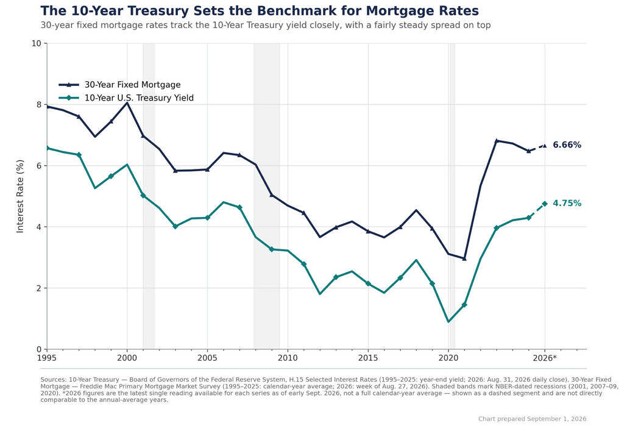
Second, mortgages, business loans, and every other kind of borrowing is priced in the same market where the federal government borrows. If Washington’s fiscal recklessness drives the government’s borrowing costs higher, borrowing costs go higher for everyone else, too.
Homes that were affordable five years ago are out of reach today in part because our government can’t get its budget in order. That has ripple effects across the entire economy — into homebuilding, manufacturing, and every family or business that borrows to accomplish its goals.
Some will tell you this can’t be fixed, that we’re too far gone. I don’t believe that, and neither should you. We remain the most dynamic, entrepreneurial economy the world has ever produced. But dynamism must be paired with discipline to solve our debt problem.
***
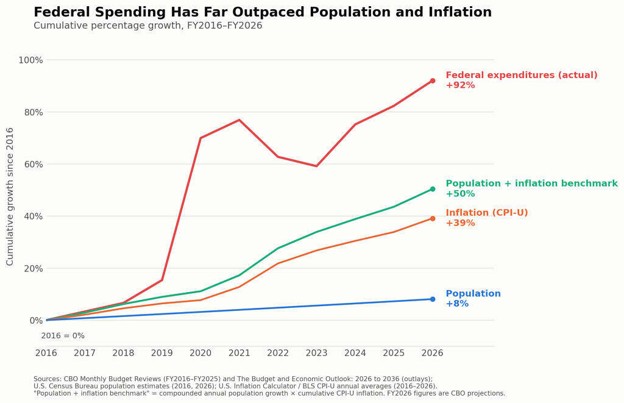
Step one: stop the bleeding. Annual federal spending increased by roughly 92% over the past decade. Meanwhile, the country’s population grew by about 8% and cumulative inflation was about 39%. Those figures compound, rather than add, so the total growth in population plus inflation is about 50%. That means the federal budget has increased at nearly twice the pace of growth in population plus inflation.
Had Congress held to a population plus inflation benchmark in its budgeting over the past decade, the national debt would be $12 trillion less than it is today. Washington must spend less than that benchmark going forward.
Congress also needs to cut spending that has no business existing in the first place. Able-bodied adults who can work should not be drawing government benefits meant for people who genuinely need them. The federal government must also get serious about policing the social safety net and prosecuting those who abuse it. The estimated cost of fraud, improper payments, and excessive billing is at least $200 billion annually.
It continues with growing our economy faster than our debt by enacting pro-growth tax reform, drastically cutting the cost of regulatory compliance on the private sector, unlocking domestic energy and mineral resources, and resurrecting American industrial output.
It won’t be painless. But it is fixable, and the alternative, the path Greece and Spain have already followed, is not a future I am willing to hand to my children, or to yours.
***
ABOUT THE AUTHOR…
Wes Climer is a candidate for the U.S. Congress who has represented the citizens of district 15 in the South Carolina Senate since November 2016. He resides in Rock Hill with his wife and five children.
First shared on Fitsnews.com and republished with permission.


Sign up here to receive the Tega Cay Sun "day" Spectator every Sunday morning with all the news from the week directly to your inbox
Thomas Hyslip lives in Tega Cay with his wife and daughter. After 27 years in the U.S. Army and Federal Law Enforcement, he retired to pursue his passion for teaching. Tom is now an Associate Professor of Instruction at the University of South Florida. In 2 short years he has won 10 awards from the South Carolina Press Association, including first place in column writing, education beat reporting and best podcast.