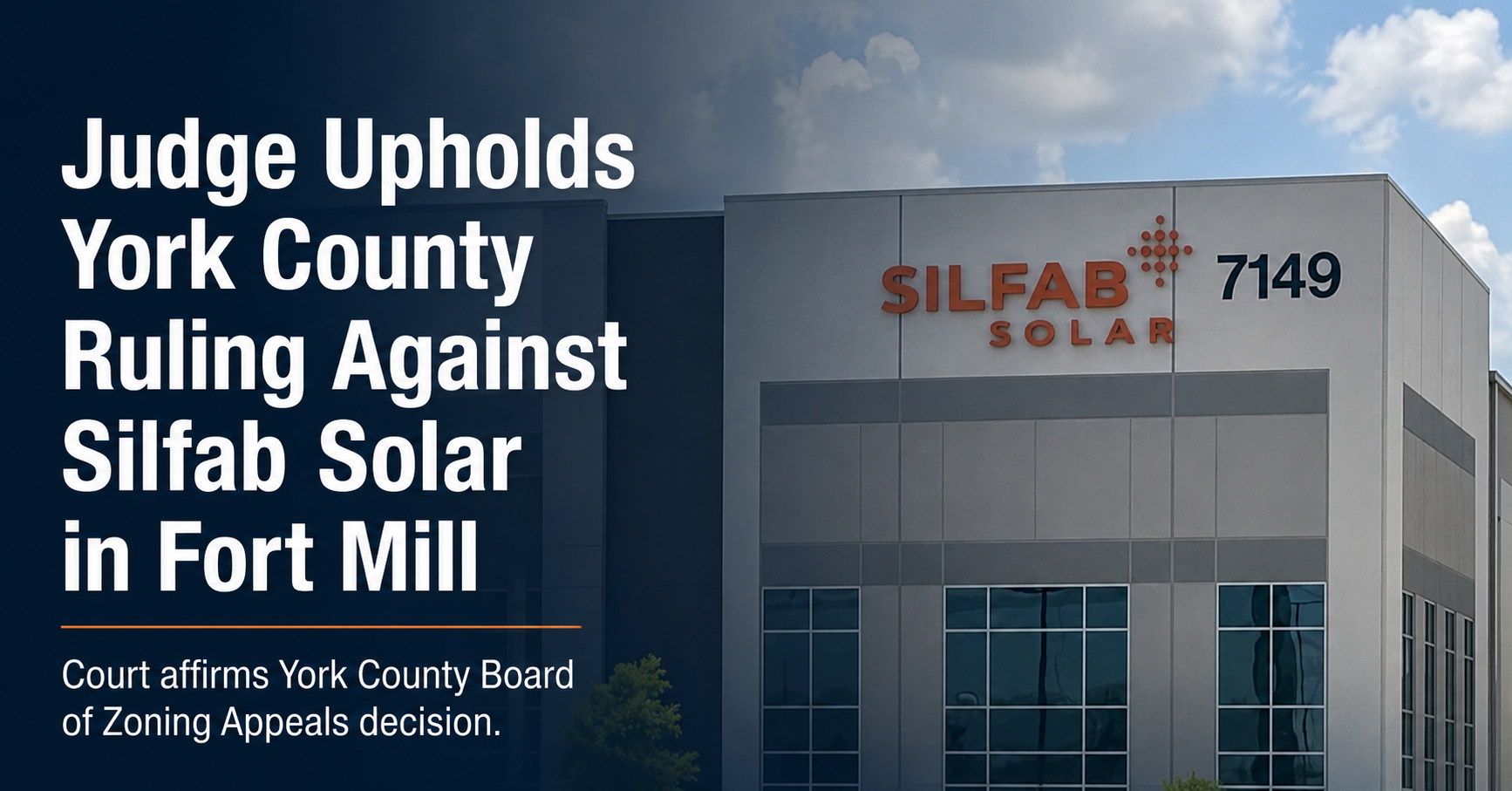

A South Carolina circuit judge has upheld a York County zoning board decision in a case involving Silfab Solar’s planned manufacturing operation in Fort Mill, denying Silfab and the property owner’s appeal over whether the use is permitted on the Light Industrial site.
Circuit Judge William A. McKinnon of the Sixteenth Judicial Circuit electronically signed and filed the order Tuesday, July 21, affirming a May 30, 2024 decision by the York County Board of Zoning Appeals. The board had voted 5 to 0 to reverse a county zoning administrator who concluded that solar panel manufacturing was allowed on the property.
The ruling affirms that the type of manufacturing at issue is not a permitted use in the Light Industrial district under the category the administrator relied on. Silfab’s facility sits at 7149 Logistics Lane, where Exeter 7149 Logistics owns the land and Silfab is the tenant. As the ruling now stands, Silfab cannot rely on the “Computer and Electronic Products Manufacturing” category to operate at the Light Industrial site. It would need another valid zoning classification, a zoning code amendment, or a successful appeal.
How the dispute reached the court
The fight began with a request from Walter Buchanan, who owns property next to the Silfab site. In February 2024, Buchanan asked the county for a formal interpretation of the zoning code. The zoning administrator responded that solar panel manufacturing qualified as a permitted use under the code category “Computer and Electronic Products Manufacturing,” relying largely on the North American Industry Classification System, a federal coding scheme the county code does not reference.
Buchanan appealed to the zoning board, which held a public hearing in May 2024 and reversed the administrator. The board found that solar panel manufacturing is not expressly listed as a permitted use in the Light Industrial district, and that any use not listed is prohibited under the county code.
Silfab and Exeter appealed to circuit court. Mediation in April 2025 ended in an impasse, and the court heard oral argument in May 2026.
Why the court deferred to the board
McKinnon ruled that the board’s conclusion was a finding of fact, which under binding state Supreme Court precedent a court must affirm if any evidence in the record supports it. He wrote that the board weighed the actual activity at the plant against the code’s definitions and reasonably concluded the two did not match.
The order points to the record from the board’s hearing. Silfab’s own construction air permit application disclosed the use of hydrofluoric acid, hydrochloric acid, potassium hydroxide and silane, along with projected emissions of hydrogen fluoride and an acid scrubber stack raised from 19.7 feet to 70 feet. CDC materials submitted into the zoning record described severe health consequences associated with hydrogen fluoride exposure, and testimony noted that silane stored in compressed form can ignite spontaneously in air.
Board members voiced those concerns on the record. Chairman Blair said a production facility with a lengthy pollution scrubber led him to question whether the operation was truly a light industrial use. Board member Rob Cameron, an engineer, noted the code contained no defined slot for solar manufacturing. Board member Bud Smith said the hazards flagged by experts were not listed in the county’s documentation, and board member Lauren Hebert said the reliance on federal industry codes and the lack of clarity did not provide enough basis to uphold the administrator’s interpretation.
Arguments the court rejected
McKinnon turned aside each of Silfab’s alternative grounds. He rejected the argument that the board should have considered a different code category, “Electrical Equipment, Appliance, and Component Manufacturing,” noting that the category traced to a 2022 zoning verification letter that was never appealed and stated on its face that it did not constitute a permit. He found the board had jurisdiction to hear Buchanan’s appeal and that Buchanan had standing as an adjacent owner.
He also rejected Silfab’s claim that a 2023 fee in lieu of taxes agreement ratified the administrator’s interpretation. Such an agreement is a tax incentive instrument, the judge wrote, and it does not amend the zoning code or bind the board. A constitutional challenge, he added, was premature.
As an alternative holding, the judge found the board’s reading of the code correct as a matter of law. Solar photovoltaic panels convert sunlight into electric current and do not process or transmit signals, he wrote, so they do not fall within the code’s examples of computers, peripherals and communications equipment.
Silfab Solar released the following statement in response to Tuesday’s decision: “While Silfab Solar is disappointed by the ruling, we are pleased that the court acknowledged that the BZA’s decision was limited to determining whether solar panel manufacturing falls under one specific use category only, and left open the possibility that it may fall under other permissible use categories. More importantly, this decision has no effect on our current operations. As York County has previously confirmed, the BZA’s ruling only applies prospectively and does not affect Silfab because our project was well underway prior to the BZA’s decision. Nevertheless, we will be appealing to ensure that future opportunities to expand production and hiring remain open and to protect the zoning process from being manipulated in the future as our opponents did in this case.”
What comes next
The order affirms the board in all respects and denies the petition for appeal. McKinnon noted that his ruling does not decide whether solar panel manufacturing might fit any other code category. He wrote that nothing forecloses Silfab from seeking a fresh zoning code interpretation on a different use, and that York County Council retains authority to amend the use table at any time.


Sign up here to receive the Tega Cay Sun "day" Spectator every Sunday morning with all the news from the week directly to your inbox
Thomas Hyslip lives in Tega Cay with his wife and daughter. After 27 years in the U.S. Army and Federal Law Enforcement, he retired to pursue his passion for teaching. Tom is now an Associate Professor of Instruction at the University of South Florida. In 2 short years he has won 10 awards from the South Carolina Press Association, including first place in column writing, education beat reporting and best podcast.