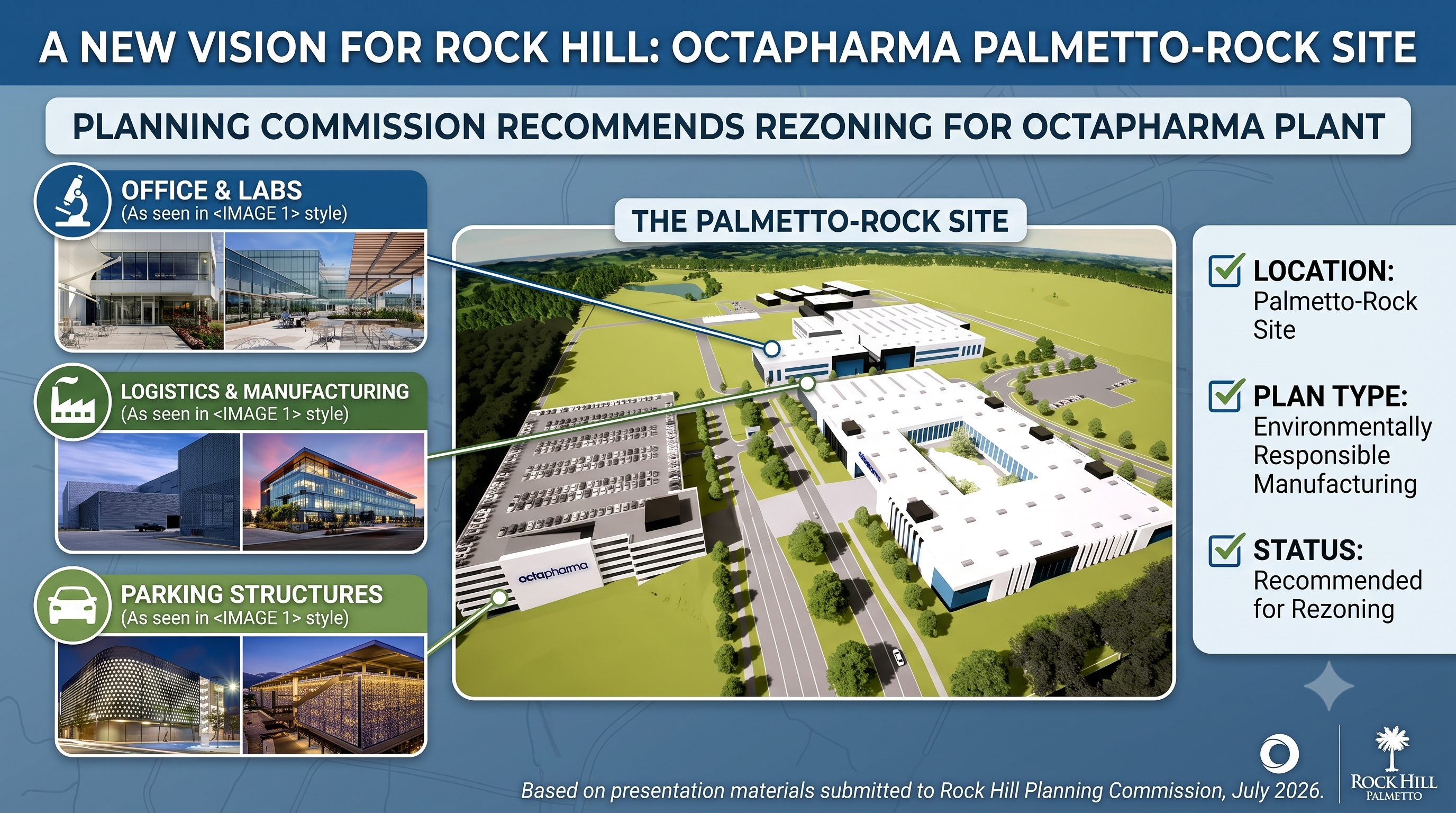

The Rock Hill Planning Commission voted 4-0 on Tuesday to recommend that City Council rezone about 50 acres near Interstate 77 and Palmetto Parkway, advancing a proposed biopharmaceutical manufacturing plant that its backers say could bring roughly 1,500 jobs and an investment approaching $1.5 billion.
The recommendation covers petition M-2026-06, filed by Bolton & Menk, Inc. of Charlotte to change the property at 3286 Palmetto Parkway from Industry General to Master Planned Business/Industrial Park. The staff report identifies the master plan as Project Palmetto Rock and the end user as Octapharma, which it describes as a human plasma fractionation facility that produces life-saving pharmaceutical products and therapies. The site is a portion of tax parcel 664-00-00-021 in the southwest quadrant of Exit 81, with roughly 1,400 linear feet of frontage on both Palmetto Parkway and Interstate 77. The item had been deferred from the commission’s May 5 meeting.
The parcel is inside the Palmetto Research Park and is currently owned by the City of Rock Hill, according to the staff report. Under the master plan’s terms and conditions, the zoning would revert to Industry General if the developer does not acquire title to the site within one year of City Council’s approval. The site sits in Ward 6, represented on City Council by Sarah Vining.
If City Council follows the recommendation, the rezoning would let Octapharma build what company representatives described as its first North American plasma fractionation plant. The company said it plans to relocate its United States corporate offices, currently about 13 miles away, to York County and to consolidate its American operations at the site. The staff report and master plan cite more than 1,000 new jobs and a maximum of 1.96 million square feet of floor area. During the hearing, company representatives put the total closer to 1,500 jobs, including about 300 corporate positions relocated to the county, and described a potential investment approaching $1.5 billion.
What the rezoning would allow
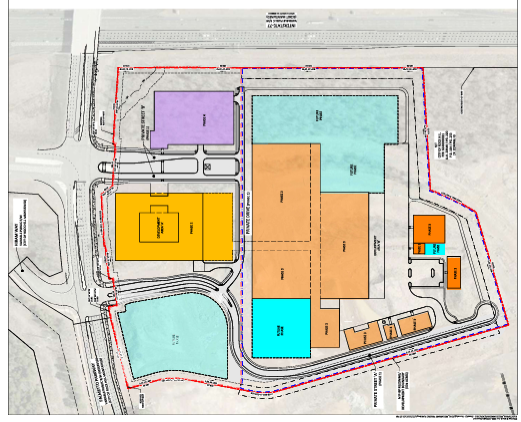
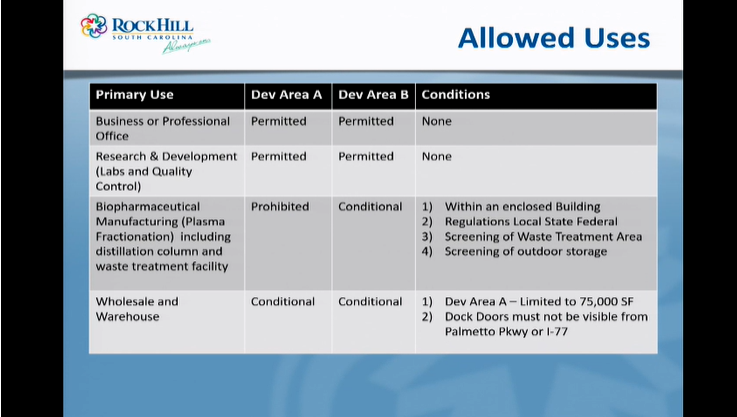
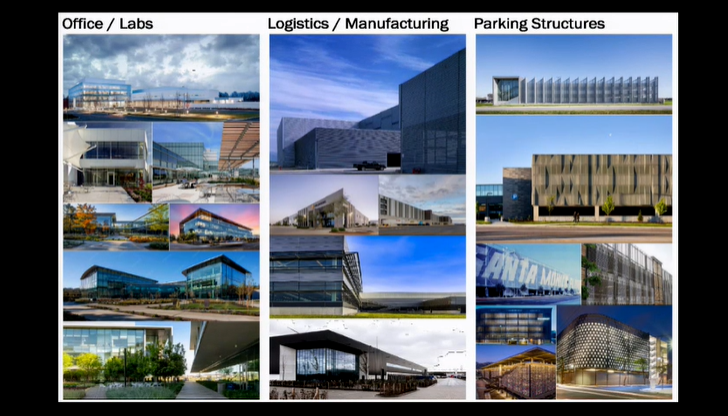
Dennis Fields, the city’s development and zoning manager, presented the staff report and recommended approval. He said the master plan divides the property into two development areas governed by different sets of allowed uses. Development Area A, closer to Palmetto Parkway, would be limited to offices, laboratories, research and development, parking and limited warehouse space, with manufacturing prohibited. Development Area B, covering the southern two-thirds of the site, would house the biopharmaceutical manufacturing operation, including plasma fractionation, a distillation column and a waste treatment facility.
The manufacturing use is written into the terms and conditions as specific to plasma fractionation, Fields said, meaning a different manufacturer could not simply take its place if the project does not move forward. At full build out, the applicant projects just under 2 million square feet, about 1.96 million, not counting a parking structure, with more than 1,000 employees and a 24-hour, seven-day-a-week operation.
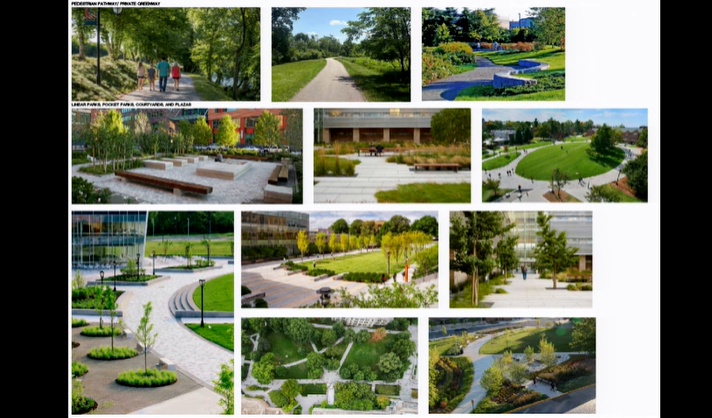
Fields said the plan carries a minimum 50-foot buffer around the entire site, which exceeds what the code would ordinarily require next to neighboring industrial and commercial property. The distillation column, likely the tallest structure on the site, would be set back at least 150 feet from side and rear property lines and at least 600 feet from the interstate under the terms and conditions.
Sean Paone of Bolton & Menk, representing the applicant, walked through a similar set of exhibits and said both access points off Palmetto Parkway would be private streets maintained by the developer, running down to the plant’s loading and service area. One western access point is built for a future signalized intersection, though no signal is installed yet. Paone said the applicant does not plan public street connections to adjacent properties, citing the security requirements of the operation.
Environmental and safety questions
Commissioners spent much of the hearing on how the plant would handle chemical waste and emissions. Paone said the facility would pretreat discharge to meet City of Rock Hill sewer standards for temperature and material before it reaches the sanitary line, and that byproduct not sent to the sewer would be held and hauled off site by licensed contractors. The terms and conditions prohibit on-site incineration.
An Octapharma representative told the commission the company neutralizes chemical discharge to levels well below federal and municipal limits, a process it has run at its five European plants over more than 40 years. Chemicals would be stored above secondary containment able to hold the full volume of any container above it, with those containers tested regularly for integrity, the representative said. Dedicated staff would monitor the waste facility, and the operation would carry monitoring, inspection and reporting requirements.
Asked about the distillation column, the representative said it functions as an exhaust vent for natural gas used to clean equipment and compared its carbon emissions favorably with traffic on the adjacent interstate, where roughly 165,000 vehicles pass Exit 81 each day. Fields noted that the terms and conditions include an environmental section spelling out that the city is not obligated to accept certain wastes and that the operation must meet federal, state, local and city wastewater requirements.
A first American plant
The company’s chief operating officer told the commission that Octapharma operates plants in the middle of cities in Sweden, France and Austria, sitting directly alongside homes and businesses, and described the company as a responsible neighbor in the communities it serves. Representatives said growing United States sales are driving the expansion, since the company currently ships plasma to Europe for manufacturing before returning finished products to American patients.
The company framed the York County site as its permanent United States home, with enough land to double manufacturing capacity in roughly 15 years, and said it would partner with local institutions including York Technical College, Clinton College and the University of South Carolina for technical, engineering and administrative hiring.
Roads, buffers and public notice
The staff report notes the parcel is affected by the RFATS Collector Street Network Plan, which envisions a collector road from Eden Terrace to Langston through the northwest portion of the property. Because the site’s internal roads are proposed as private, the terms and conditions include language that would allow that collector to be built if the developer and the city later agree to make it public. A traffic impact analysis from the earlier development covered the Palmetto Parkway interchange and its connection to Mount Gallant Road, which York County’s Pennies for Progress program has approved for widening to three lanes. An updated traffic memorandum would be required at the major site plan stage.
Staff reported no opposition from surrounding property owners. A neighborhood meeting is typically required for master planned rezonings, but the report notes it was not necessary here because there are no private property owners within 300 feet of the site, only undeveloped Palmetto Research Park land owned by the city.
No public comment, unanimous recommendation
No members of the public signed up to speak for or against the petition, and no one addressed the commission in opposition. After a motion and second, the commission voted 4-0 to recommend approval to City Council.
A separate tax deal in the balance
The rezoning is only one of the approvals Project Palmetto Rock needs, and a parallel piece is in a tougher spot. York County and Octapharma Plasma, Inc., the Delaware company behind the project, have negotiated a fee-in-lieu-of-taxes agreement, a common economic development tool that lets a company pay a negotiated fee instead of full property taxes. The draft agreement describes an investment of about $1.29 billion and roughly 1,152 new full-time jobs over an eight-year investment period, with the property placed in the York-Chester Industrial Park, a multi-county park York County shares with Chester County.
Under the draft terms, the county would assess the project at a 4 percent ratio, below the standard rate, and lock the millage at 430.0 mills, adjusted every five years. The county would also grant special source revenue credits that offset the fee payments by 50 percent for the first 10 years, 35 percent for the next 10 and 20 percent for the following 10. Each phase of the project would remain in the fee arrangement for up to 40 years.
The sticking point is not the incentive itself but who absorbs its cost. At the county’s June 29 second reading, which passed 7 to 0, Council adopted a 5-2 amendment from Councilman William “Bump” Roddey that changed how the tax break is split among the three taxing bodies. Under the amendment, York County continues to forgo 50 percent of its potential revenue from the project and Rock Hill Schools’ share drops from 50 percent to 31.9 percent, while the city of Rock Hill’s rises from 50 percent to 100 percent, meaning the city would give up all of its potential property tax revenue. The change does not alter what Octapharma pays. Councilmen Andy Litten and A. Watts Huckabee, Sr. voted against the amendment.
That shift collides with a condition Rock Hill City Council attached to its own approval. On June 22, the city council voted 5 to 0 to give conditional consent to including the Palmetto Research Park property in the multi-county park and to the fee agreement, but only for as long as the city keeps receiving its proportional share of the property tax or fee revenue. Because the county’s amendment removes that share, the county attorney advised that Rock Hill City Council must take a new vote authorizing the restructured terms before the agreement can be finalized. If the city declines and the county holds its position, the deal as structured could stall.
What happens next
York County Council is set to take up third and final reading of the fee ordinance at a special called meeting Wednesday, July 8, at 6 p.m. at the York County Heckle Complex on Heckle Boulevard in Rock Hill. Earlier county materials had listed the third reading for July 13, so the timing bears watching. For the incentive to take effect, Rock Hill City Council would still need to act on the amended revenue split.
The Planning Commission’s rezoning recommendation is a separate track that now goes to Rock Hill City Council, which gave the rezoning ordinance first reading before Tuesday’s meeting, with second reading to follow on a date the city will post. The public hearing portion of Planning Commission meetings can be viewed at cityofrockhill.com/livestream, and City Council agendas are posted at cityofrockhill.com the Friday before each meeting.
Octapharma Deal in Jeopardy After York County Amendment Strips Rock Hill’s Tax Share


Sign up here to receive the Tega Cay Sun "day" Spectator every Sunday morning with all the news from the week directly to your inbox
Thomas Hyslip lives in Tega Cay with his wife and daughter. After 27 years in the U.S. Army and Federal Law Enforcement, he retired to pursue his passion for teaching. Tom is now an Associate Professor of Instruction at the University of South Florida. In 2 short years he has won 10 awards from the South Carolina Press Association, including first place in column writing, education beat reporting and best podcast.