
As families across York and Lancaster Counties prepare for the Fourth of July, one of the nation’s founders left behind a prediction that came remarkably close to reality, with one notable exception. He picked the wrong day.
Writing to his wife, Abigail Adams, from Philadelphia on July 3, 1776, John Adams forecast almost exactly how future generations would mark American independence. He simply believed they would do it two days earlier than they eventually did. His letter has become one of the most quoted pieces of correspondence from the Revolutionary era, and it carries added weight this year as the country marks the 250th anniversary of independence on Friday.
A prophecy for the ages
Adams wrote that Americans would honor the birth of their nation with festivity from one corner of the continent to the other. His words have echoed through two and a half centuries of parades, cookouts and fireworks displays.
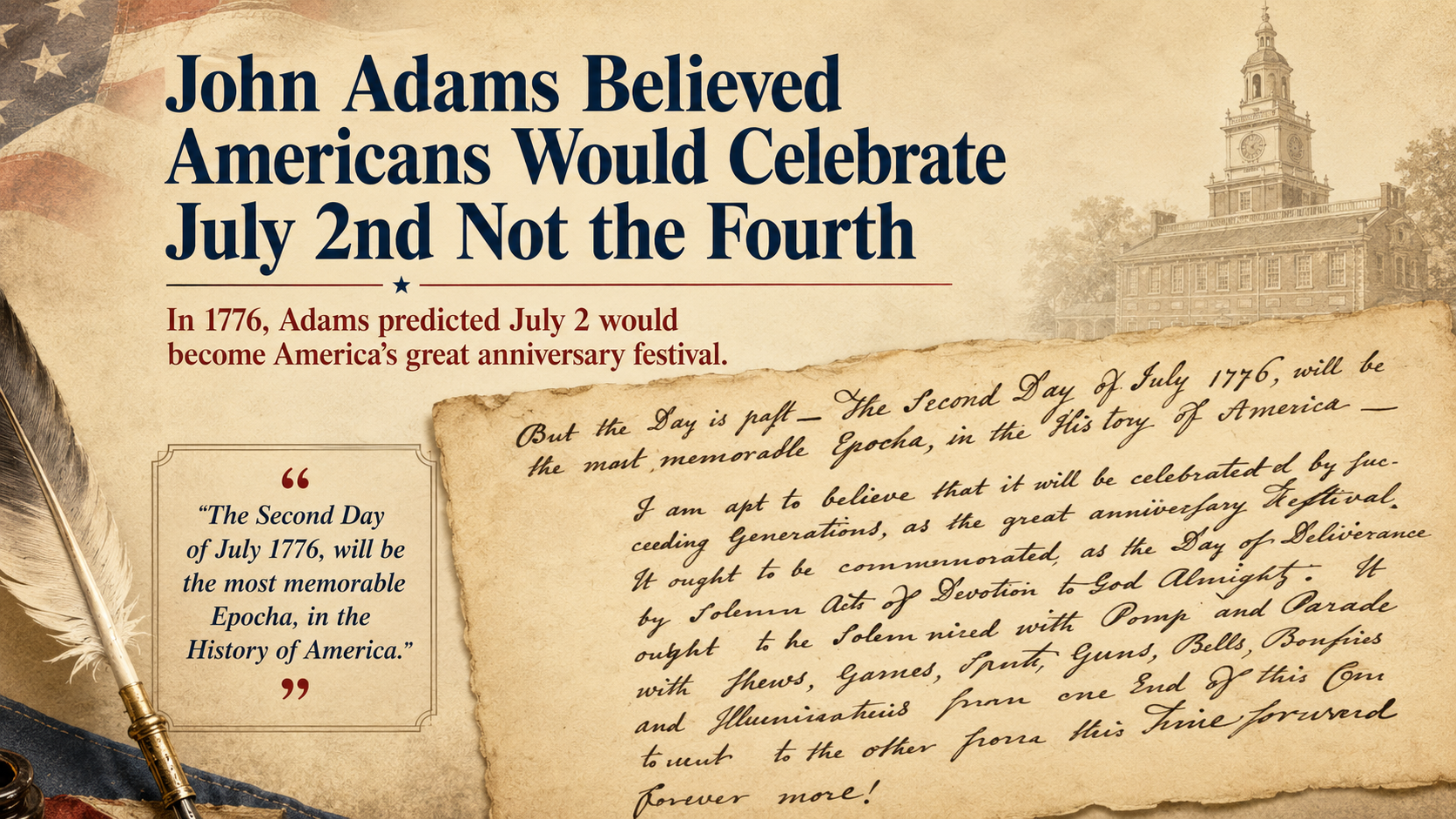
“The Second Day of July 1776, will be the most memorable Epocha, in the History of America,” Adams wrote. “I am apt to believe that it will be celebrated, by succeeding Generations, as the great anniversary Festival. It ought to be commemorated, as the Day of Deliverance by solemn Acts of Devotion to God Almighty. It ought to be solemnized with Pomp and Parade, with Shews, Games, Sports, Guns, Bells, Bonfires and Illuminations from one End of this Continent to the other from this Time forward forever more.”
The vision proved accurate. The date did not.
Why Adams pointed to July 2nd
Adams anchored his prediction to the day Congress actually voted for independence. On July 2, 1776, the Continental Congress approved the resolution introduced by Richard Henry Lee, formally declaring the colonies free and independent states. To Adams, that vote was the decisive act, and he expected it to become the anniversary the country would observe.
The date that entered the American calendar was July 4, the day Congress approved the final wording of the Declaration of Independence. Copies known as the Dunlap Broadsides were printed and distributed carrying that July 4 date, and the printed document, rather than the earlier vote, fixed the Fourth in the public memory.
Adams was right about the pomp, the parades, the bonfires and the guns. He was two days off on when they would happen.
An unlikely footnote
The story carries one more turn of history. Adams died on July 4, 1826, on the 50th anniversary of the adoption of the Declaration. On the very same day, his friend and rival Thomas Jefferson, the document’s principal author, also died. Two of the nation’s founders passed within hours of each other on the anniversary neither Adams had expected the country to keep.
The original letter is held by the Massachusetts Historical Society as part of the Adams Family Papers and can be read through the society’s online archive.
As communities across the region gather this weekend for the 250th observance of American independence, the celebration will unfold much as Adams described it, on the day he did not choose.
Source material: Letter from John Adams to Abigail Adams, July 3, 1776, Adams Family Papers, Massachusetts Historical Society; Founders Online, National Archives.


Sign up here to receive the Tega Cay Sun "day" Spectator every Sunday morning with all the news from the week directly to your inbox
Thomas Hyslip lives in Tega Cay with his wife and daughter. After 27 years in the U.S. Army and Federal Law Enforcement, he retired to pursue his passion for teaching. Tom is now an Associate Professor of Instruction at the University of South Florida. In 2 short years he has won 10 awards from the South Carolina Press Association, including first place in column writing, education beat reporting and best podcast.