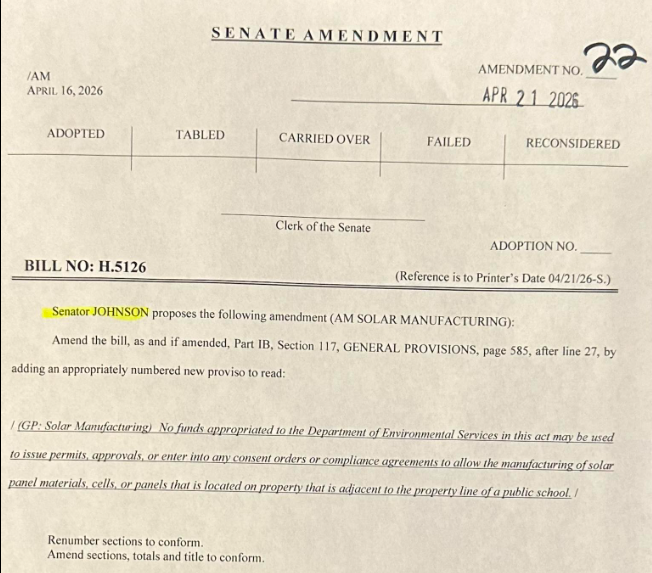

State Senator Michael Johnson, who represents Fort Mill and Tega Cay in District 16, has sponsored and passed a budget proviso in the South Carolina Senate that would block the Department of Environmental Services from taking any action that could allow Silfab Solar to resume manufacturing operations at its Fort Mill facility.
The amendment, designated Amendment No. 22 to H.5126 and dated April 16, 2026, targets Section 117 of Part IB of the state budget under General Provisions. If it survives the full legislative process, the proviso would prohibit SCDES from issuing permits, approvals, or entering into any consent orders or compliance agreements that would allow the manufacturing of solar panel materials, cells, or panels at a facility located on property adjacent to the property line of a public school.
The Silfab Solar plant on Logistics Lane sits adjacent to Flint Hill Elementary School.
“I just sponsored and passed a budget proviso stopping the Department of Environmental Services from entering into any additional agreements with Silfab,” Johnson said. “My goal is to stop DES from allowing Silfab to restart manufacturing. This proviso will go to the House. Hopefully they keep it in the budget.”
The amendment now moves to the South Carolina House of Representatives, where it must survive budget negotiations before it could become law.
The proviso arrives roughly six weeks after a pair of chemical incidents at the Silfab facility triggered a statewide response. On March 3, approximately 300 gallons of potassium hydroxide spilled at the plant. Two days later, on March 5, a second incident involving hydrofluoric acid prompted the closure of Flint Hill Elementary School, where students missed two full days of instruction. The South Carolina Department of Environmental Services ordered Silfab to immediately cease all operations following the incidents, and both state and federal investigators launched inquiries into the company’s practices.
York County Emergency Management initially reported that 1,530 gallons of potassium hydroxide had been released during the March 3 incident before revising that figure to 300 gallons. The discrepancy drew public criticism and fueled calls for accountability. State Rep. David Martin publicly noted at the time that he had not received clear verification of the actual amount spilled.
The school closure forced the Fort Mill School District to grapple with state mandates requiring makeup instructional days. The South Carolina Department of Education informed the district that the two missed days at Flint Hill could not be waived, citing eLearning policy and the availability of remaining calendar days. The school board considered and ultimately tabled a proposal to address those makeup days at its April meeting.
Senator Johnson’s proviso represents the most direct legislative action yet aimed at preventing Silfab from resuming production near a school. The language of the amendment does not name Silfab by name but is written in terms that directly describe the company’s situation, given the location of the Logistics Lane facility relative to Flint Hill Elementary.
The proviso language reads: “No funds appropriated to the Department of Environmental Services in this act may be used to issue permits, approvals, or enter into any consent orders or compliance agreements to allow the manufacturing of solar panel materials, cells, or panels that is located on property that is adjacent to the property line of a public school.”
Whether the House retains the provision in its version of the budget will be a key question as the legislative calendar moves toward a conference committee report expected in mid to late May.
Source: Senate Amendment No. 22 to H.5126, dated April 16, 2026; statement from Sen. Michael Johnson, District 16


Sign up here to receive the Tega Cay Sun "day" Spectator every Sunday morning with all the news from the week directly to your inbox
Thomas Hyslip lives in Tega Cay with his wife and daughter. After 27 years in the U.S. Army and Federal Law Enforcement, he retired to pursue his passion for teaching. Tom is now an Associate Professor of Instruction at the University of South Florida. In 2 short years he has won 10 awards from the South Carolina Press Association, including first place in column writing, education beat reporting and best podcast.