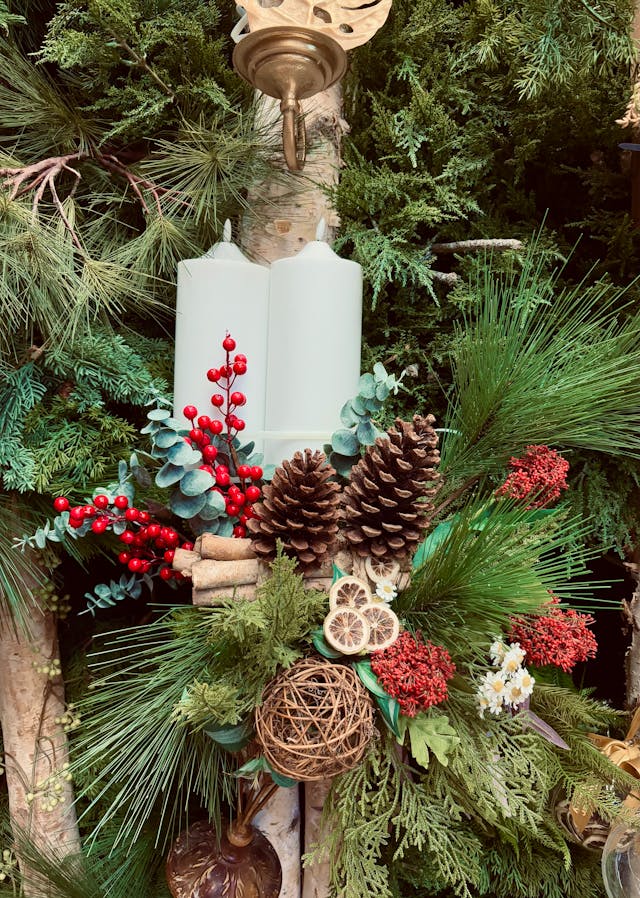

Given that this is the season, it’s likely that you’ve seen holly and ivy just about everywhere you look. We decorate with them, we garland with them, we sing about them, we use the real thing, we use the fake version, and every other Christmas card has one or the other or both featured on it somewhere. Nothing seems unusual about this. We take it in stride as part and parcel of this celebrated time of the year. But why holly and ivy?
Any good encyclopedia of Christian iconography will reveal what follows, as will any good subject-specific encyclopedia. I will not badmouth the Internet either, but it can, at times, be a bit off kilter. Gen Z and Gen X must forgive this septuagenarian for his bias here.
Without getting too deep into Christian iconography, holly and Ivy didn’t begin with this tradition. Druids, or pagans, used it far sooner than the Christian tradition. Both are evergreens, so there is something magical about them surviving throughout the winter, even when those winters were much harsher than the ones we experience today. Given holly and ivy’s endurance through the most unbearable conditions, having them nearby meant you had a ready-made alexicacon, a charm to subvert evil. Holly and ivy together meant you had a double apotropaic against any evil that might come your way. The sharp points on holly were especially symbolic: spear-like, they could be used to fight evil. Again, because both lasted all year, they came to symbolize enduring friendship. To give someone ivy meant you trusted them and that you had only goodwill for them.
Christian iconography was slow to pick up on this. The same sentiment then still surfaces today: can we acquire something used by pagans in the Christian tradition? Chesterton is to the point here. He argued that paganism was a necessary precursor since it put people where they needed to be: in or near the temple, the place of worship. Giving holly and ivy, but especially holly, to those you loved meant you thought of them in the same way: your love for them was enduring, everlasting, as it were.
The holly also has pointed tips, which, if you bunch them together, may well make a crown, a crown of sorrows, or one fit for a king. Its red berries also, when taken together, can hark back to the blood of Christ and his enduring, everlasting sacrifice for us. The baby in the manger is a sweet image to be sure. But do not forget where that baby ended his life, a mere 33 years later.
Ivy, given its penchant for clinging to everything it came near, became a symbol for one’s love for Christ. It meant you intended to be faithful through thick and thin, through hardships, through great darkness, and even through overwhelming sorrow. It’s a wonder that it isn’t used more often at weddings as a symbol of one’s love.
We have to remember that until writing was perfected and people learned to read, the only way to convey the Christian message was through images. Tour any medieval churches in Europe, and you can see this today. In some that remain, the entire message of the Christian truth is on the façade, from Genesis through Revelation. The illiterate could stand before the outside of the church and get the sermon before entering. Granted, to modern minds, the Revelation part could be a bit on the harsh side (look at some of Hieronymus Bosch’s works, especially “The Garden of Earthly Delights”), but this was a time when trigger warnings were unheard of, and sin was a really, really dreadful thing. These images lasted until the Restoration, when they fell out of favor, but once it ended, they returned.
Holly and ivy still have significant meaning today. In addition to the obvious ones mentioned above—enduring, everlasting—they still convey a strong message to those willing to see it. The two together still mean something that does not die, something that does not end, and something that will hang on, as it were, through the bitter periods. They mean that whoever holds them will last and not falter through life’s tumultuous times. They mean, if you think hard about it, everlasting life.
Google the lyrics to “The Holly and the Ivy,” and you’ll see what I mean. It did not become a well-known hymn until the early 1900s, when Cecil Sharp, a folk song collector, got it from Mary Clayton. But the use of the two together does go back to medieval times. Without getting into another soapbox of mine, medieval times are neither dark nor to be dismissed.
So the next time you hear or sing “The holly and the ivy/ When they are both full grown/Of all the trees in the wood/The holly bears the crown,” think on these things.
Merry Christmas!