
The Email Looked Exactly Right
Imagine you are in the middle of closing on your new home. Your real estate attorney sends you an email with updated wire transfer instructions. The sender’s name looks right. The email address looks right. The message sounds professional. You wire the money.
It is gone within hours, drained from an account controlled by criminals before you realize anything is wrong.
That is not a hypothetical. It is exactly what happened to multiple victims across the United States in one of the largest business email compromise schemes ever prosecuted in South Carolina. And this week, a federal jury in Columbia made sure the people behind it will answer for it.
The Verdict
On June 11, 2026, after seven days of trial, a federal jury convicted Demani Jawara Bosket, 51, of Saluda, South Carolina, and his niece Tanya Lashawn Bosket, 53, of Charlotte, North Carolina, on multiple counts of wire fraud conspiracy and conspiracy to commit money laundering. Demani Bosket was found guilty on six separate counts of wire fraud. Tanya Bosket was found guilty on four counts.
Demani Bosket now faces up to 30 years in federal prison and fines of up to $50 million. Tanya Bosket faces up to 20 years and the same potential fine. Seven other members of the fraud ring entered guilty pleas before the trial concluded, including defendants from Charlotte, Jacksonville, Savannah, and Auburn, Washington.
The case was investigated by the U.S. Secret Service, IRS Criminal Investigation, FBI Columbia Field Office, Homeland Security Investigations, and the U.S. Agency for International Development Office of Inspector General. The Secret Service was able to recover approximately $2.5 million to return to victims, a fraction of the more than $25 million stolen between 2020 and 2024.
How the Scheme Worked
This was not a smash-and-grab operation. It was a patient, methodical, and highly sophisticated transnational fraud that unfolded in carefully coordinated stages.
It began overseas. Foreign criminal entities identified target companies and gained unauthorized access to their email systems. Once inside, they did not immediately steal anything. Instead, they watched and waited, monitoring email communications for weeks or months, searching for signs of an upcoming large financial transaction, a real estate closing, a vendor payment, a loan disbursement, an inheritance transfer.
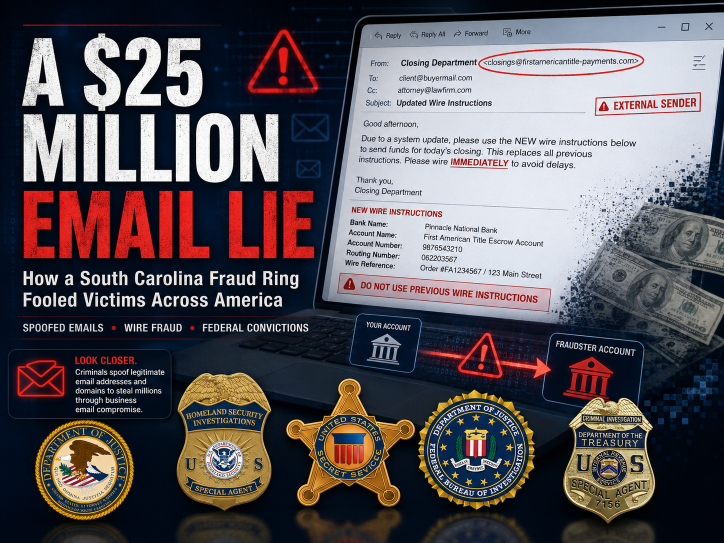
When the moment arrived, they struck. Using what are known as spoofed email addresses, the criminals sent fraudulent messages to victims impersonating attorneys, title company representatives, business partners, or bank officials, redirecting payments to accounts they controlled.
Those accounts were where Demani and Tanya Bosket came in. According to evidence presented at trial, Demani Bosket served as a U.S.-based recruiter and manager for the fraud ring, instructing co-conspirators to register sham businesses with state authorities and open bank accounts in those businesses’ names. When stolen funds arrived, Bosket directed members of the ring to drain the accounts immediately through cash withdrawals and cashier’s checks, moving money through multiple accounts to prevent banks and victims from recovering it. A portion was kept by the U.S.-based ring members before the remainder was sent overseas.
The targets ranged from construction companies and private equity firms to title companies, law firms, and even individuals receiving inheritance transfers. Victims testified during trial that they had no idea they were communicating with criminals until their money was already gone.
What Is a Spoofed Email Address and How Do You Spot One
This case hinges on a technique that is deceptively simple and devastatingly effective. Understanding it could protect your bank account, your business, and your home purchase.
A spoofed email address is one that is designed to look like a legitimate address at a quick glance but contains a subtle difference. The criminal is not actually sending from your attorney’s real account. They are sending from an account they created that looks almost identical.
Common spoofing tricks include swapping letters that look similar, such as a lowercase L for the number 1, or a zero for the letter O. They add or drop a single character, for example yourlawfirm.com versus yourIawfirm.com with a capital i instead of a lowercase L. They use a completely different domain that sounds plausible, such as firstamericantitle.net instead of firstamericantitle.com. They add a word that seems legitimate, such as payments.yourbank.com instead of yourbank.com.
At a glance, especially on a mobile phone where the full address is often hidden, these differences are nearly invisible.
How to Protect Yourself
The good news is that a few simple habits make this scam extremely difficult to pull off against you.
Never wire money based solely on an email instruction. This is the golden rule of wire fraud prevention. Before wiring any amount of money, always call the sender directly using a phone number you already have on file, not one provided in the email. Confirm the wire instructions verbally before sending a single dollar.
Look at the full email address, not just the display name. On most email platforms, the sender’s display name can say anything the criminal wants it to say. The actual email address is what matters. On a phone, tap the sender’s name to expand the full address. On a computer, hover over or click the sender name to reveal it.
Be especially suspicious of any email that changes previously agreed payment instructions. Legitimate real estate attorneys, title companies, and vendors very rarely change wire instructions at the last minute. A sudden change in payment details, especially via email alone, is one of the clearest red flags in the book.
When in doubt, pick up the phone. If you receive any email requesting a financial transfer or change of payment details, call the sender using a number you have independently verified. One phone call is all it takes to expose this entire class of fraud.
As U.S. Attorney Bryan Stirling put it after the verdict: “The jury saw through this scheme and rendered the right verdict.” Thanks to the patience of federal investigators and the testimony of victims, a criminal ring that stole $25 million over four years is now facing the consequences. But the best outcome is one where the money never gets stolen in the first place.
Stay safe out there, and I will see you next week!
Feeling lost in the digital world? Dr. Tom is here to help!

Sign up here to receive the Tega Cay Sun "day" Spectator every Sunday morning with all the news from the week directly to your inbox
Thomas Hyslip lives in Tega Cay with his wife and daughter. After 27 years in the U.S. Army and Federal Law Enforcement, he retired to pursue his passion for teaching. Tom is now an Associate Professor of Instruction at the University of South Florida. In 2 short years he has won 10 awards from the South Carolina Press Association, including first place in column writing, education beat reporting and best podcast.