
How The Patriot turned the Carolina Piedmont into Revolutionary War South Carolina and made Rock Hill the center of the movie world for a season
In the fall of 1999, something unusual began appearing along the back roads of York County, South Carolina. Catering trucks rolled past cotton fields. Generators hummed in the predawn dark. Men in tricorn hats and knee breeches smoked cigarettes near craft services tents, their muskets propped against equipment cases. Hollywood had come to the Carolina Piedmont, and for 101 days, it would not leave quietly.
The production was The Patriot, director Roland Emmerich’s sweeping Revolutionary War epic starring Mel Gibson and a young Heath Ledger. Filming ran from September 1999 to January 2000, with the entire movie shot in South Carolina and York County serving as the production’s headquarters. By the time cameras wrapped, the film had accomplished something remarkable for a rural Piedmont county still trying to grow beyond its textile mill roots:
The land was the casting call
Director Emmerich and his location scouts faced a specific and demanding problem. To recreate the Carolina backcountry of the 1770s, they needed rolling hills, hardwood forests, open fields, and historic structures, all without the intrusion of modern agricultural equipment, power lines, or suburban development creeping into frame. They needed a place that still looked, at least from certain angles, like it hadn’t entirely left the 18th century.
They found it here.
The production demanded acres of rolling hills and trees without the intrusion of modern crops, which were found at the Guy Darby Farm on Darby Road in Chester County, about seven miles southwest of Rock Hill. That farm became the workhorse of the production, it served as the location for many of the film’s battle scenes as well as largely cut scenes of Valley Forge, and also served as the production base of operations for nearly four months, where many of the reenactors camped out between shooting days.
Production headquarters, meanwhile, were planted firmly in Rock Hill. Revolutionary War reenactment battles were staged in Rock Hill as well, meaning the city’s streets and surrounding land occasionally found themselves populated by hundreds of men in Continental blue and British red, firing black powder charges into the crisp autumn air.
Brattonsville: already a set, just waiting
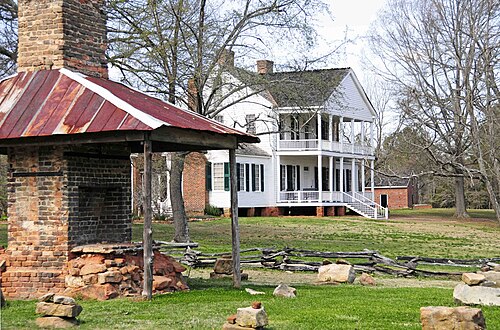
If any single York County location was born to appear in The Patriot, it was Historic Brattonsville in McConnells.
The living history museum, located in York County’s Olde English District, spans over 700 acres and features more than 30 historic buildings and costumed interpreters. The site was already interpreting Revolutionary War history before a single camera truck arrived, on July 11, 1780, a British Legion troop arrived at the plantation of Patriot colonel William Bratton and threatened his wife Martha for information about her husband’s location. The very ground where the production would film had already absorbed the footsteps of people who lived the story being told on screen.
Hightower Hall, the Colonel Bratton House, and the Homestead House were all used in the production. The Homestead House in particular carried real dramatic weight in the film: it served as the house where Aunt Charlotte, played by Joely Richardson moves after Charlestown falls to the English. The surrounding plantation grounds doubled as multiple locations throughout the film, with portions serving as Charlotte Selton’s rural plantation, the Continental encampment, and interior scenes.
Today, visitors to Brattonsville can walk directly through those scenes. The Homestead House now contains an exhibition with memorabilia from the movie, and visitors can walk through many of the sets and locations that provided the backdrop for the film. It’s an unusual layering of history, a Revolutionary War site that became, two centuries later, a movie set recreating its own past.
A production that took authenticity seriously
Emmerich’s film was not, by any scholarly measure, a work of strict historical accuracy. Gibson himself would later call it “sheer fantasy.” But the production took its craft seriously, and that diligence showed in how it treated its York County locations.
Producer Mark Gordon said the team “tried their best to be as authentic as possible” because “the backdrop was serious history.” Producer Dean Devlin and the film’s costume designers examined actual Revolutionary War uniforms at the Smithsonian Institution prior to shooting. When Revolutionary War reenactors were hired by the hundreds to fill battle sequences near Rock Hill, they brought their own deep knowledge of period tactics, weaponry, and dress.
The cinematographer, Caleb Deschanel, drew out the particular quality of light that the Piedmont offers in autumn, long, golden, and low, with a softness that makes open fields look almost painterly. Those images, exported to theaters worldwide in the summer of 2000, were very much images of York County, dressed in another century’s clothing.
Hurricane Floyd, winter cold, and the work of it
The shoot was not without its hardships. The threat of Hurricane Floyd caused delays in the production, though it did not actually hit any of the filming locations. The 101-day schedule pushed well into January 2000, meaning the cast and crew worked through the coldest months of the year in the Carolina Piedmont. For the hundreds of reenactors and local extras hired to fill battle sequences, that meant long days in wool uniforms on cold fields, waiting between takes for the next volley, the next charge, the next camera reset.
Local businesses in Rock Hill and the surrounding area felt the production’s presence. Hotels filled. Restaurants ran longer hours. The county had not seen an economic infusion quite like it from a single private enterprise.
What remains
The Patriot opened nationwide on June 30, 2000, and grossed over $215 million worldwide. The reviews were mixed, critics praised Gibson’s performance and Deschanel’s photography while questioning the film’s liberties with history but audiences embraced it.
In York County, the film left something behind that no box office number quite captures. It left the knowledge that these fields, these old buildings, these particular stretches of Piedmont road were good enough to pass for the founding of a nation. That the land here was convincing as 18th-century South Carolina because, in the ways that mattered to the camera, it still was.
Historic Brattonsville became internationally known after its appearance in the film. Visitors still come specifically because of The Patriot, to stand in the Homestead House dining room where Gibson’s scenes were shot, to walk the grounds where the Continental encampment was staged, to hold that strange double-vision of past and present that only certain places can offer.
The reenactors broke camp. The generators went quiet. The catering trucks moved on. But for a season, York County was the center of the world Mel Gibson and Roland Emmerich were building and the county held up its end of the bargain beautifully.
Historic Brattonsville is located at 1444 Brattonsville Road, McConnells, SC 29726, and is open to the public. The Homestead House contains exhibition materials from the production of The Patriot.

Sign up here to receive the Tega Cay Sun "day" Spectator every Sunday morning with all the news from the week directly to your inbox
Thomas Hyslip lives in Tega Cay with his wife and daughter. After 27 years in the U.S. Army and Federal Law Enforcement, he retired to pursue his passion for teaching. Tom is now an Associate Professor of Instruction at the University of South Florida. In 2 short years he has won 10 awards from the South Carolina Press Association, including first place in column writing, education beat reporting and best podcast.